France has taken part in the TIMSS and PISA assessments of mathematics education since the 1980s. Each round produces a set of rankings. For a few days, they delight the media and unsettle and alarm those in charge of education systems, but they very often leave teachers and parents bewildered, if not sceptical. Everyone wonders whether their country is really performing as well—or as poorly—as these assessment results suggest. With their eyes fixed on the thermometer, they wonder whether the rise or fall observed between two assessments is significant—and, if so, what it signifies…
What the thermometer measures
--------------------------------
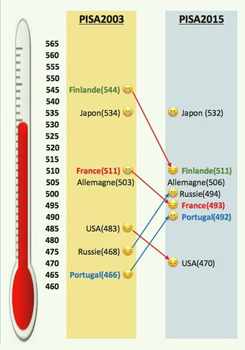
On PISA's mathematical literacy scale—the thermometer—France fell from a score of 511 in 2003 to 493 in 2015, while Russia rose from 468 to 494. Statistical analysis shows that these differences are significant: mathematics education in these countries really did change. But what exactly, and why? Finally, what lessons can be drawn from these results when it comes to taking action?
Fortunately, PISA and TIMSS do more than publish rankings and scales: they also provide information on how education systems operate and on the relationships observed between this information and students' measured attainment. For example, they highlight the (statistical) relationship between attainment and class size, the effort a country devotes to teacher training, or the enjoyment students derive from going to school or doing mathematics. These so-called contextual variables are numerous (the full assessment reports run to thousands of pages and should not be read too hastily).