Central perspective, rigorously established by Filippo Brunelleschi in Florence in the early 15th century, long remained the preserve of painters. It was not until Girard Desargues developed projective geometry in the 17th century that geometers took up this tool and formalized its effects. Since infinity suggested a representation of God, it interested thinkers and artists before it concerned mathematicians, who long regarded it merely as a source of insurmountable paradoxes.
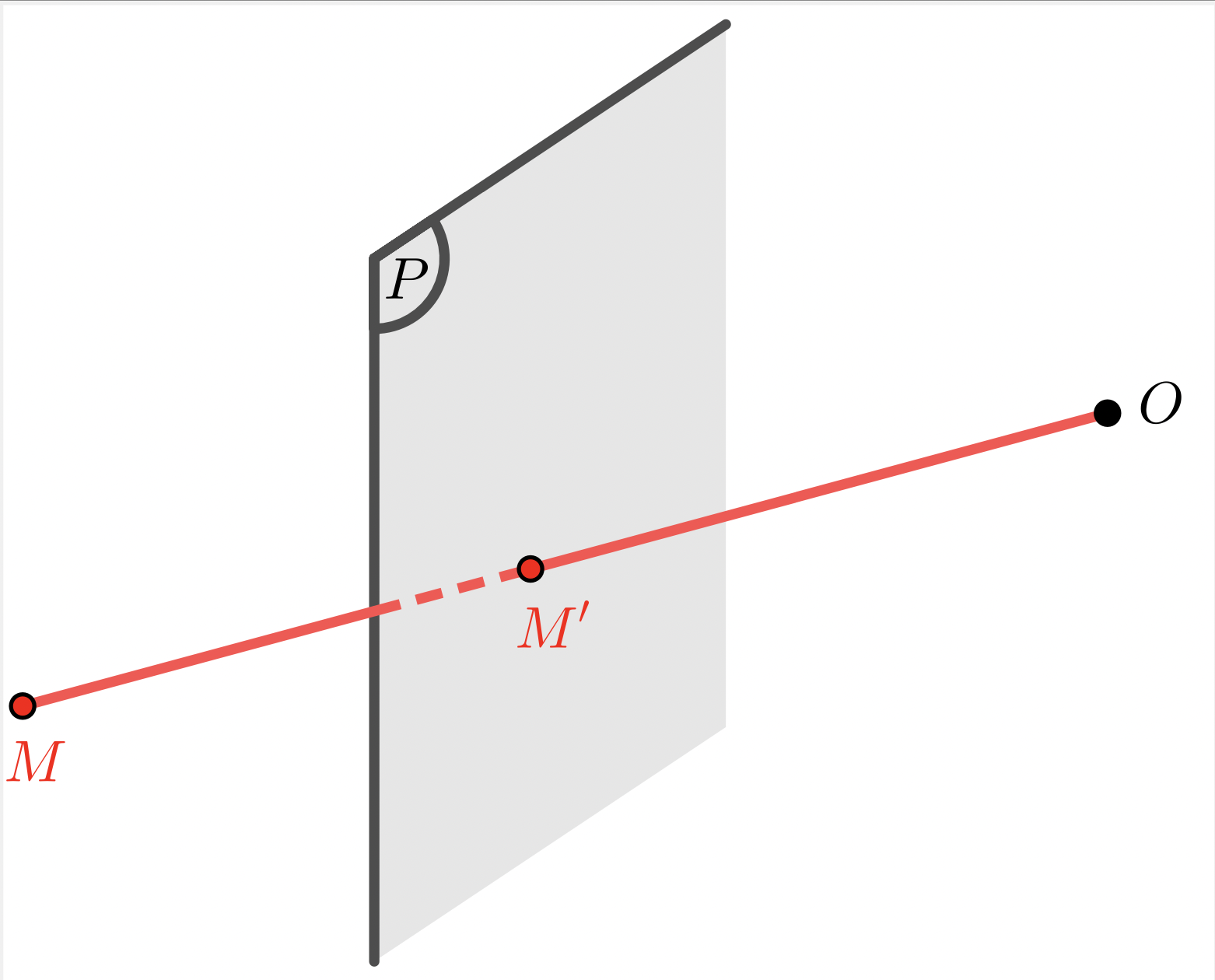
Central (or conical) perspective involves choosing a viewpoint O and a projection plane (or surface) P, then, for every point M in space other than O, finding the intersection M′ of the line (OM) with P.
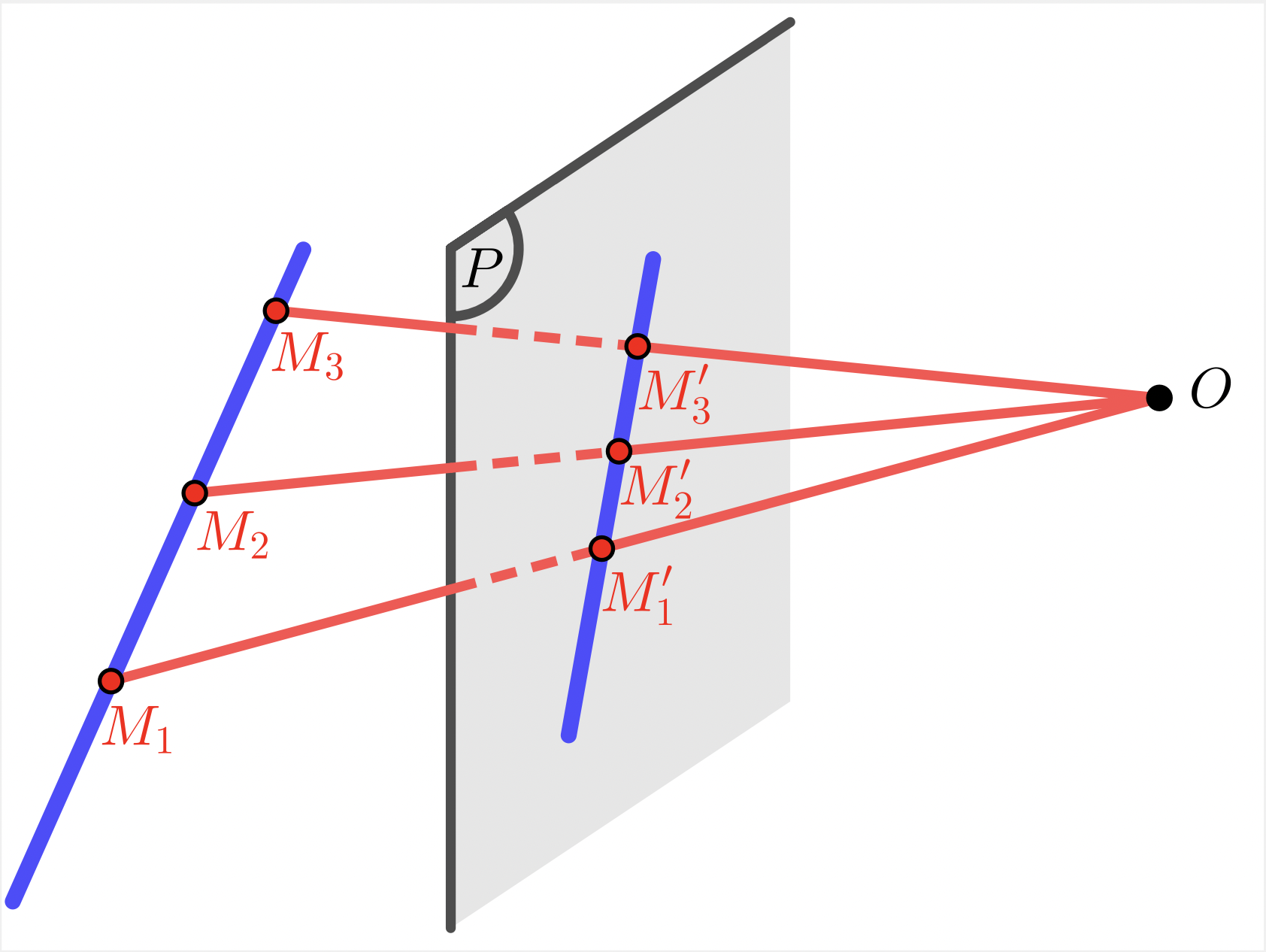
The first major property of this projection is that it preserves collinearity: if , and are three collinear points in space, then their projections , and onto are also collinear.