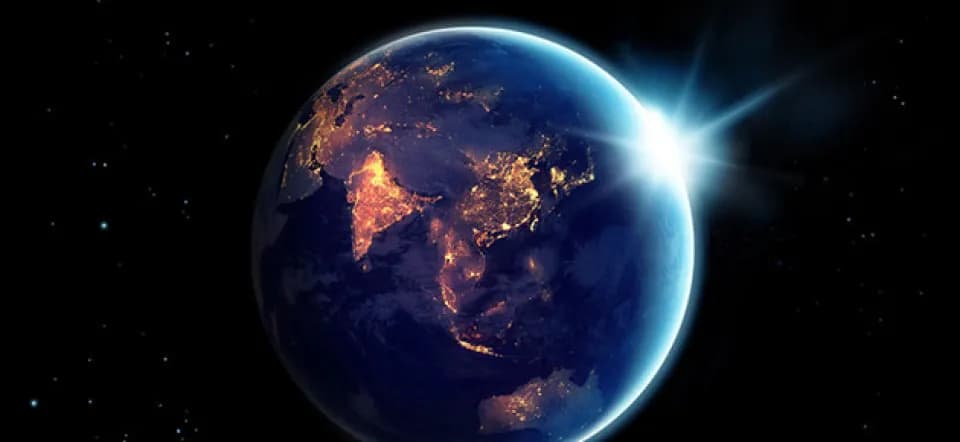
B.R.: The title of your book says that the Earth is out of shape, but reassure us: it is still round, isn't it?
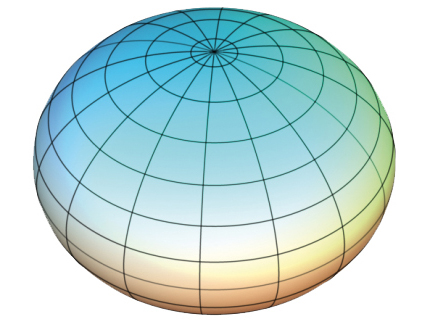
X.C.: Let's say it is "almost round"! We have known since Newton that the Earth's surface is better described by an ellipsoid of revolution, that is, an ellipse rotated about its minor axis. Our planet bulges at the equator, but as a first approximation it can safely be regarded as spherical.
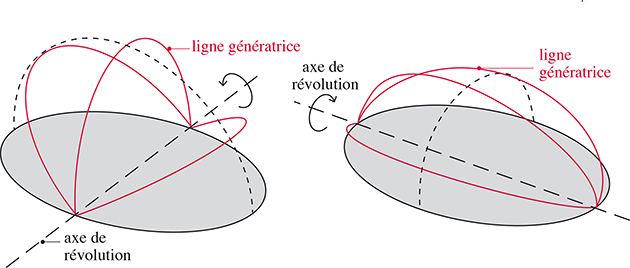
An ellipsoid of revolution is obtained by rotating an ellipse about one of its two axes.
When did people realize that the Earth was roughly spherical?
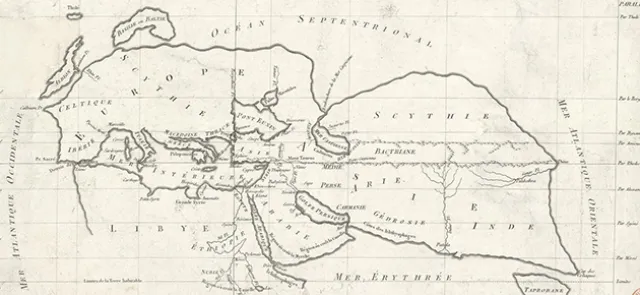
There is a common misconception about this. Many people wrongly believe that the Earth was thought to be flat before the modern era. That is simply untrue: all educated people had known perfectly well for a very long time that the Earth was round. Written evidence of this idea dates back to ancient Greece. The Pythagoreans, as well as Plato, had already proposed a spherical Earth, although they defended the idea with arguments that would not convince a physicist today. Aristotle, however, offered a decisive argument in the 4th century BCE: during a lunar eclipse, he observed that the shadow cast by the Earth on the Moon was curved like a circle. From this, he inferred that the Earth was round. Aristotle also noted—although we do not know whether this second argument was his—that a ship seems to sink below the horizon as it moves away, demonstrating the curvature of our planet in another way.