
Viruses typically measure on the order of a nanometer—one billionth of a meter (1 nm = 10 –9 m), or one millionth of a millimeter. Today, microscopes can reveal viral particles in a clinical sample or in infected cells. Besides revealing the sometimes highly unusual shapes of certain viruses, they show the "holes" these viruses can make in a layer of bacteria. These are known as plaques; they are formed by bacteriophages, or phages—viruses capable of infecting bacteria, replicating within them and lysing them.
The extent of a lysis plaque depends in particular on the viruses’ ability to multiply. It is therefore useful to be able to calculate the area of such regions, which are both microscopic and potentially very irregular in outline.
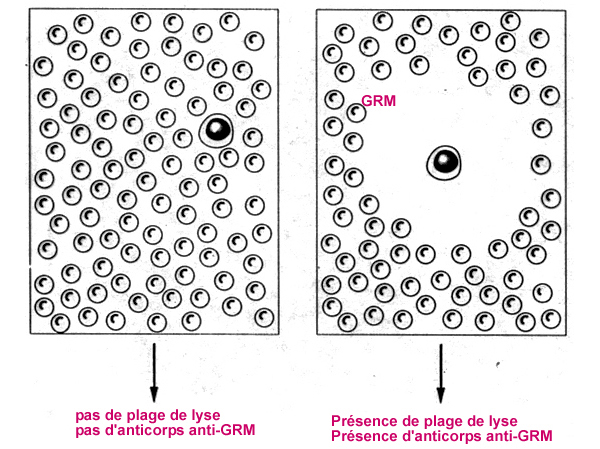
The basic principle for solving such a problem is to estimate the area of a lysis plaque using that of a polygon whose vertices lie on the plaque’s outer boundary. Naturally, the more points selected, the more accurate the resulting approximation.
-