



The mathematics of knots
For millennia, sailors (and more recently climbers) have used knots to tie their ropes. Interlacements, already present in Roman decorative art, are found in Islamic and Celtic motifs. At the end of the 19th century, Tait and Thomson, through a hypothesis – which proved to be false – of chemical bonds that would interlace, brought knots into the realm of mathematics. Do you like tying strings or untangling the hanks of your balls of wool? Knot theory is made for you! Mathematical challenges are not lacking there. Without knowing it, Gauss, in studying certain curves, had laid the groundwork for this theory, which makes it possible to generate knots systematically, to classify them, to understand their connections with graph theory or to distinguish them 'at first glance' with the help of a complete invariant... which still remains to be constructed.
All articles in this folder
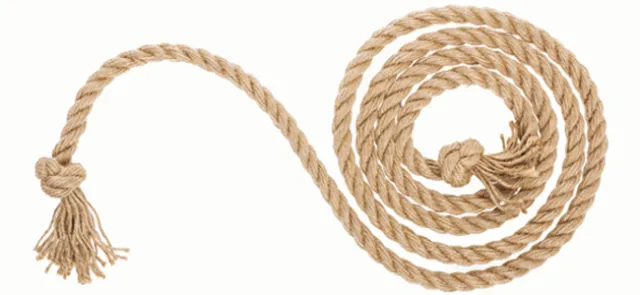
Classifying knots: topology and invariants | Tangente
Knots can be combined to form new ones—or, conversely, simplified. We can borrow the vocabulary of number theory and classify them rather like the chemical elements. What varied and unexpected facets knot theory has!
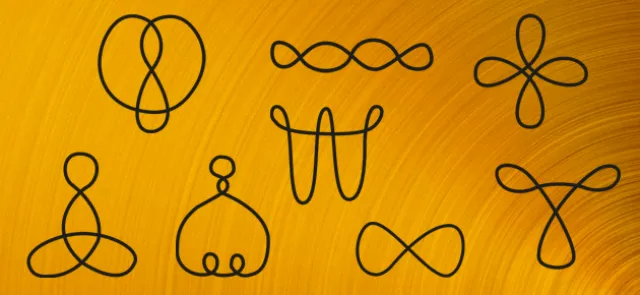
Identifying knots with Gauss codes | Tangente
A visual encoding introduced by Gauss to make knots easier to recognize and manipulate leads to surprising developments in combinatorics, algebra and topology. Armed with paper, pencil and a few pieces of string, let's explore this world.
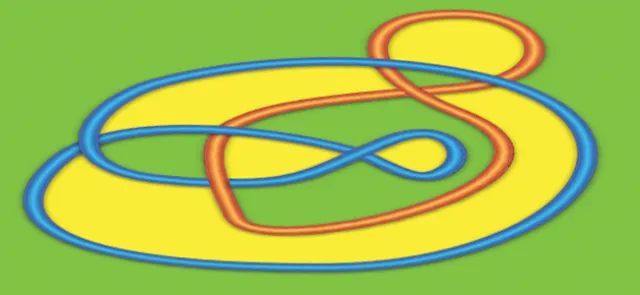
Links and graphs: a two-way connection | Tangente
What do links and planar graphs have in common? They are connected by a relationship that associates a graph with any given link and, conversely, provides a simple way to encode—and therefore draw—any link using a graph.
Vaughan Jones, a "pure genius" of knot theory
If ever there was a knot theorist, it was Vaughan Jones. This New Zealand-American mathematician, a 1990 Fields Medalist, is now renowned worldwide for his contributions to knot theory. French mathematician Alain Connes (born in 1947 and himself a Fields Medalist) described his discoveries as "work of pure genius".
Artists’ visions: knots in art and maths | Tangente
Three artists share their visions of knots.