-
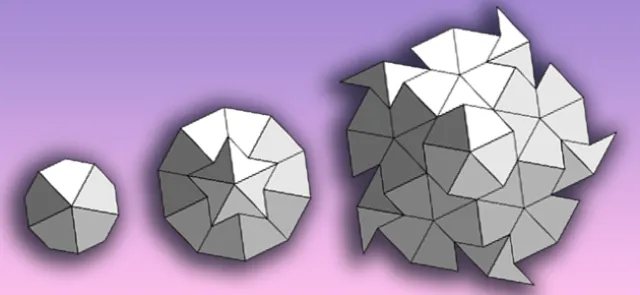
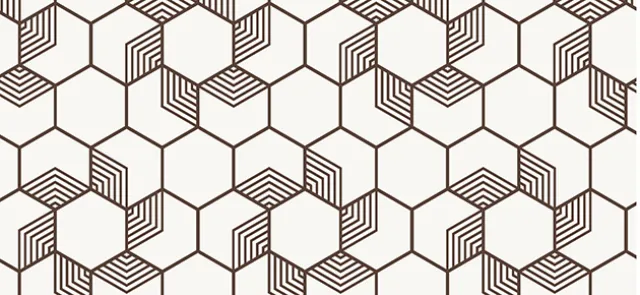
Some tilings are periodic: they are invariant under two translations by non-collinear vectors (think of bathroom tiles made up of squares, parallelograms or hexagons). Tilings can also be non-periodic: a carefully chosen isosceles triangle can produce a kind of spiral that is not invariant under any translation. This raises the following question: given a set of tiles that tile the plane, is it possible for none of the resulting tilings to be periodic?
The long quest for aperiodicity
--------------------------------
Part of what makes the puzzle of aperiodic tiles so intriguing is the question of whether tiles that impose local tiling constraints can also impose constraints globally, across the entire plane.
In his 1964 thesis, American mathematician Robert Berger (born in 1938) proved that an aperiodic set of tiles exists. He even proposed a set of 20,426 shapes! The race was on: could anyone do better? Berger soon reduced his own tally to 104 tiles, before other brilliant mathematicians, including Donald Knuth, Raphael Robinson and Roger Penrose, brought the number down to 92, 35, 34, 16 and finally six in 1971.