In the service of curves
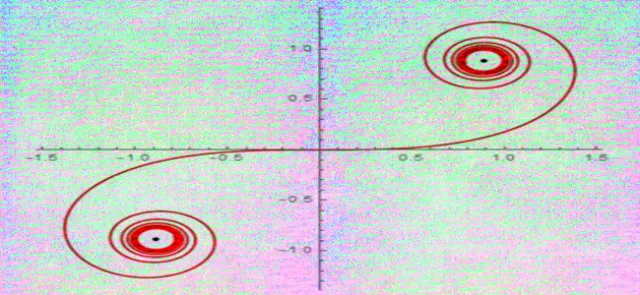
Through the magic of analytic geometry, the properties of an algebraic formula find visual expression in the corresponding curves. Taylor expansions play an absolutely crucial role in this constant interplay.


Through the magic of analytic geometry, the properties of an algebraic formula find visual expression in the corresponding curves. Taylor expansions play an absolutely crucial role in this constant interplay.


Articles recommended for you.

There are essentially two ways to define a plane curve using equations: with a Cartesian (or implicit) equation, or with parametric equations.

Confusing "tangent" and "asymptote" is a very common mistake: what student has never made it? Yet the distinction between the two notions is perfectly clear. An exploration of certain constructions in projective geometry will nonetheless force us to call our certainties into question.

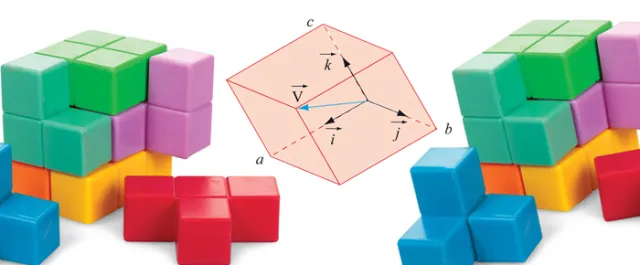
Not all curves in space are confined to a plane. To study these "space curves," several new concepts—curvature and torsion—are introduced using a carefully chosen frame of reference. Get to grips with them and learn how to use them!

The notion of a square root can be extended to very general sets. One may then obtain more than two square roots—even infinitely many! Matrices provide one example. Orientation-preserving similarities, viewed through the lens of complex numbers, lead us back to less startling results.
Discussion
Sign in to post a comment and talk with other readers.
No comments yet. Be the first to respond.