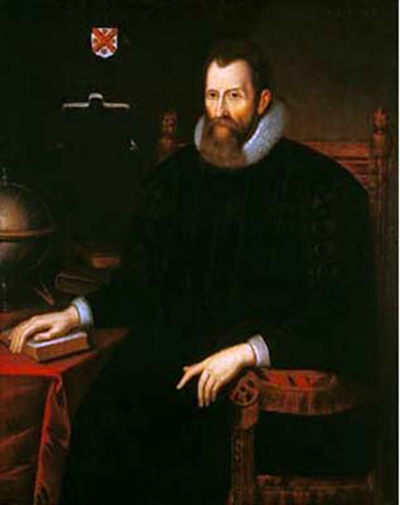
John Napier (1550–1617).

The first power-series expansions of functions emerged alongside the development of differential and integral calculus in the late 17th century. Truncating them produces Taylor polynomials!


Articles recommended for you.

Replacing the function itself with a Taylor expansion is justified only if this approximation does not alter the calculation of the properties being studied, whether a limit, an upper bound, or something else. The behavior of the remainder is therefore important.

The differences between physicists' and mathematicians' notation might seem like mere turf wars, and thus reconcilable with a little common sense. There are several reasons for these differences

At the time of his death, Isaac Newton was proud to have found a method for solving problems in natural philosophy, but he was aware of its limitations. The Moon's trajectory is described only very approximately by the two-body problem. It fell to Joseph-Louis Lagrange to make a spectacular breakthrough.

How can the classical exponential function be extended to complex numbers? Will its usual properties be preserved? Although the resulting extension is easy to study, the associated notion of a complex logarithm is more elusive. It was the subject of controversy in the 18th century.
Discussion
Sign in to post a comment and talk with other readers.
No comments yet. Be the first to respond.