You've come across a visible watermark. But there are invisible ones too—and they are far more dangerous…
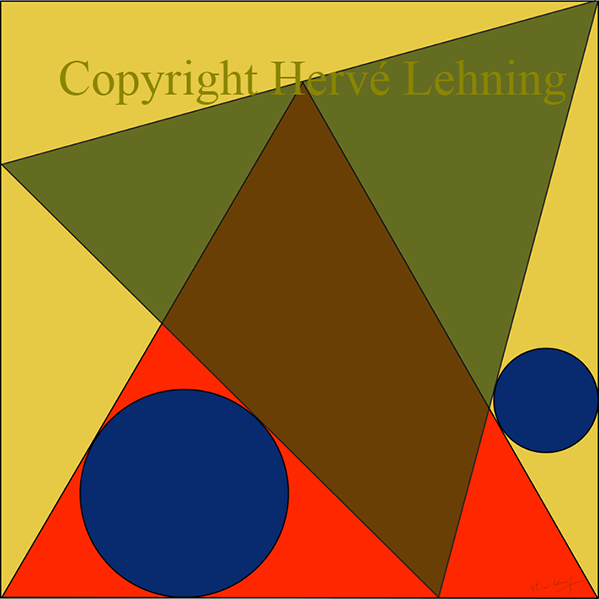
The story is a familiar one. You create an image—a sangaku-style geometry puzzle, for example—only to find it online under another author’s name. One solution is to put your image credit in the caption, though this does not deter every unscrupulous user. In that case, you can include the legal notice directly in the image, discreetly or otherwise.
This way of watermarking an image is normally intended to prompt anyone wishing to use it to acquire the rights.
####
Image visibly watermarked using basic drawing software.
Sending a message discreetly
------------------------------
An image can be used to convey messages via the Internet. Here is how. A drawing is a sequence of bits. If the resolution is high enough, changing a few bits that encode the color, for example, will not alter the image very much. You can decide to modify every 50th bit, replacing those bits with the bits of your message in whichever encoding you choose (ASCII or another). At present, no one seems capable of detecting this kind of tampering.
The principle dates back to antiquity. It involves hiding the message you want to convey, rather than merely hiding its meaning, as in cryptography. This is known as steganography. As a precaution, it is advisable to combine the two methods by embedding the encrypted message as a watermark.

References:
Cryptography and Secret Codes. Tangente Library 26, 2013.
The Bible of Secret Codes. Hervé Lehning, Flammarion, 2019.