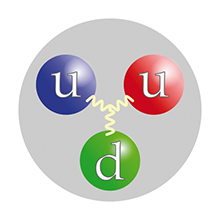
In 1964, the American physicist Murray Gell-Mann (1929–1919), who won the Nobel Prize in Physics in 1969, proposed a model to explain the multitude of particles observed in accelerators: they were all thought to be built from even smaller building blocks—the ultimate fragments of matter—called quarks and characterized by a color. Quarks come in blue, red and green, although these names have nothing to do with our perception of color.
And yet… One of the assumptions of quantum chromodynamics is that the color charge of a free particle must be zero—that is, colorless—and therefore… white. Consequently, the three quarks making up a proton or neutron each carry a color such that, when combined, they produce an absence of color. Hence the choice of the primary colors: red, green and blue!