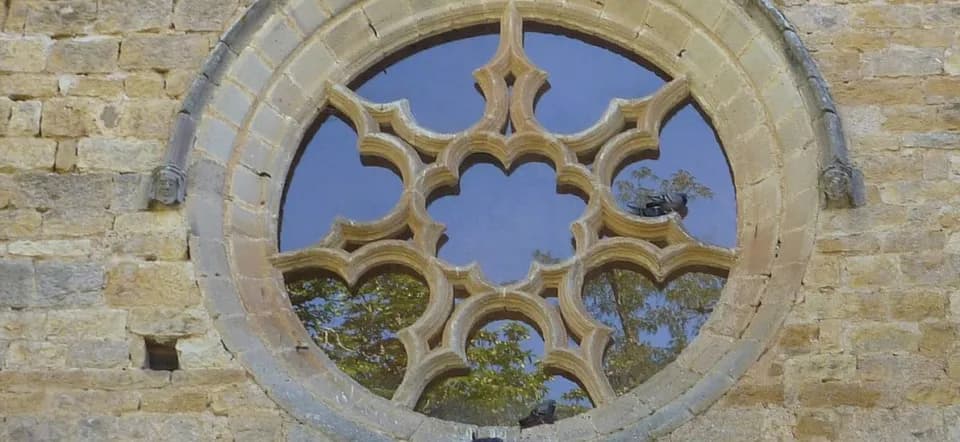
**Rose window on the west façade of the church at the Cistercian Abbey of
Notre-Dame de Beaulieu-en-Rouergue (Ginals, Tarn-et-Garonne), founded in 1144.
The local builders evidently had a particular fondness for the number 7,
since the nave extends into a seven-sided apse.**
A straightedge can be used to draw the line through two points, while a compass can transfer a given length and draw either a circular arc or a complete circle. The builders' first requirement was to construct a perpendicular—in other words, a right angle. To do so, they could draw on any of the following geometric properties:
• The perpendicular bisector of a line segment (the line through two points that are each equidistant from the segment's endpoints) is perpendicular to the segment at its midpoint;
• In a triangle, if the line segment joining a vertex to the midpoint of the opposite side (the median) has half the length of that side, then the angle at that vertex is a right angle;
• If a triangle inscribed in a circle has the endpoints of a diameter as two of its vertices, then the angle at its third vertex is a right angle;