The Voronoi–Delaunay concept has properties prized in modelling (imaging, networks, etc.). It combines Voronoi diagrams with Delaunay triangulations (see boxes). From a finite sample of points selected on a surface, these models generate structures that are robust, quick to determine and rich in information about that surface. They also have obvious artistic and graphic appeal, something that has not escaped the Nantes visual artist Bernard Cornet (**https://bern-art-cornet.fr**).
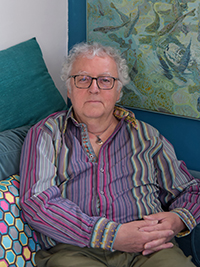
Tangente: What led you to draw on mathematics in your paintings?
B.C.: I have always drawn and painted, and I hold degrees in physics and visual arts. My earliest paintings depicted landscapes and realistic, surrealist or fantastical scenes; I then moved towards more post-Impressionist work. Semi-abstract creations gradually allowed me to break free from figurative art. My search for new non-figurative forms led me to draw inspiration from science and mathematics, as well as digital art.
Could you explain what prompted you to use the geometry of Voronoi cells (see box)?