On a perfectly flat surface, the resulting geometric figure is obviously a disk—or a circle if we are interested only in the boundary of the region defined in this way. But exactly which notion of distance should we choose?
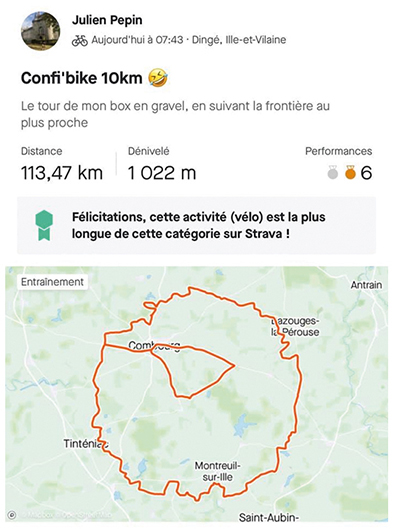
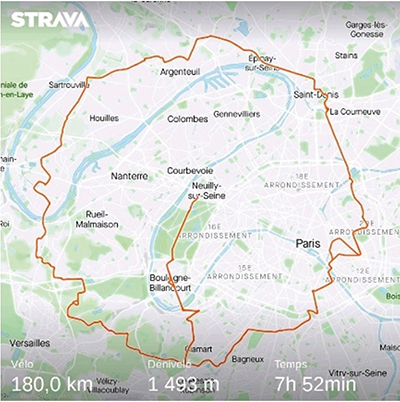
Mathematicians were not the only ones to have fun with this rule… It also inspired hiking and cycling enthusiasts everywhere. The object of the game was to "circle Jean Castex's cage" while staying "as close as possible" to the circle of radius 10 km! Modern technology then made it easy to plot the route taken on an IGN map.
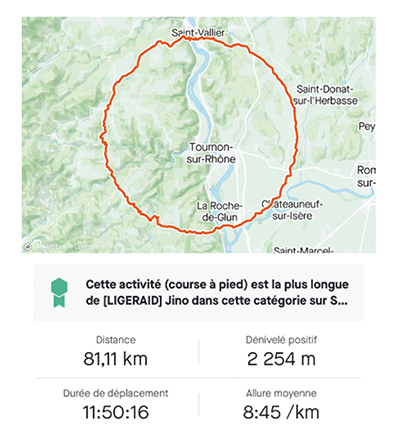
Some spice up the game, such as Jean-Noël Poméon and four fellow adventure racers, who accomplished the feat around Tournon-sur-Rhône, a charming subprefecture of Ardèche: using a compass, taking bearings, crossing the Rhône by kayak, making their way up a canyon, crossing forests and fields of brambles… and even running on asphalt! All while observing the curfew.
The results raise the question of how to minimize the distance travelled. A circle of radius 10 km has a circumference of approximately 62.832 km. Our Ardèche athletes covered just over 81 km, around 30% farther. Can anyone do better? The problem is less trivial than it seems: did the question of the dimension of fractal objects not arise from considering how to measure the coastline of Great Britain?
Source: