The pleasure of tackling mathematical problems and puzzles often comes from the time spent exploring several avenues before finding the one that leads to the solution. That is certainly true of the 14 puzzles presented here. Although the statements are preceded by hints—each group of problems has a subheading identifying one of the key techniques to use—readers are encouraged to think for themselves before turning to the final two pages of this article.
Be inventive
-------------
Every mathematical tool allows us to move back and forth between reality and a concept. Martin Gardner is best known for sparking and sustaining interest in recreational mathematics through his articles in Scientific American and the books in which they were later collected. In Aha! Insight (W.H. Freeman & Co., 1978), translated into French as *Haha ou l’éclair de la compréhension mathématique (Pour la science, 1992), he takes us inside the mathematician's mind so that we can experience this flash of insight for ourselves. For the unexpected to occur, we must learn to be inventive. The often surprising solution is then the product of what he calls the "Aha"*.
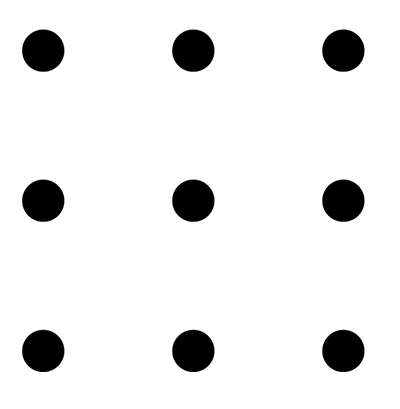
"Thinking outside the box" describes an original and creative way of thinking. Simple as it appears, the nine-dot problem existed long before the expression. It is attributed to Sam Loyd. Henry Dudeney Dudeney later published it. In the 1970s, it was fashionable for some consultants to use it.
1. Can the nine dots be joined by drawing four straight lines without lifting the pencil from the paper?