Sylvester's problem | Tangente
Sylvester's problem
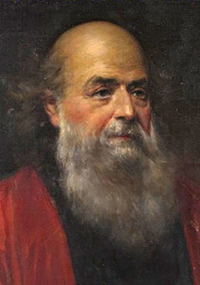
In 1893, the British mathematician James Joseph Sylvester (1814–1897) posed the following question in the Educational Times.


In 1893, the British mathematician James Joseph Sylvester (1814–1897) posed the following question in the Educational Times.


Articles recommended for you.

Long after the 19th century, the golden age of geometry, Erdős took an interest in problems whose statements could appear in an elementary textbook. Among these are two jewels of elegance: the Erdős–Mordell theorem, which involves nothing more than a triangle, and the Erdős–de Bruijn theorem, which features only points defining lines.

Algebraic curves come in every degree and every variety. They can be represented in the real plane, the complex plane or even the projective plane. How can we find our way around? Learn to recognize them and navigate this rich geometric universe!

The idea of pairing two mathematical objects according to a set of rules allows us to extend certain results without reinventing everything: that is the whole point of duality. Or, mathematically speaking, how to kill two birds with one stone.

The line is the simplest geometric figure imaginable. The variety of situations encountered in geometry may seem more complicated, and yet… might there be a special perspective from which the plane could be understood as a line? That is precisely what projective geometry is about!
Discussion
Sign in to post a comment and talk with other readers.
No comments yet. Be the first to respond.