The equidecomposability theorem
----------------------------------
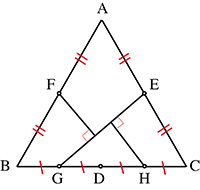
The Scottish mathematician William Wallace (1768–1843) was the first to prove this property, in 1807. Unaware of Wallace's result, the Prussian mathematician Paul Gerwien proved it again in 1833, as did Farkas Bolyai in 1835 (see Découpages et Pavages, Bibliothèque Tangente 64, 2018). The proof of this equidecomposability theorem rests on two properties: every polygon can be triangulated (divided into finitely many triangles), and every triangle can be cut into pieces and rearranged to form a rectangle with a prescribed base.
Constructing the puzzle
-------------------------
The following construction sometimes appears in the literature.