Born in Paris to Italian parents, Jacques Dominioni began learning painting and sculpture at the age of 14 and studied academic drawing at the Louvre. In 1950, he met the painter Raymond Dauphin (1910–1995), who taught him about color and landscape painting.
He later left Paris for Italy before settling in the south of France. He studied ceramics and woodworking in Vallauris and Vence (Alpes-Maritimes), where he met Matisse and Picasso. Finally, in 1980, he settled in La Tardière, Vendée.
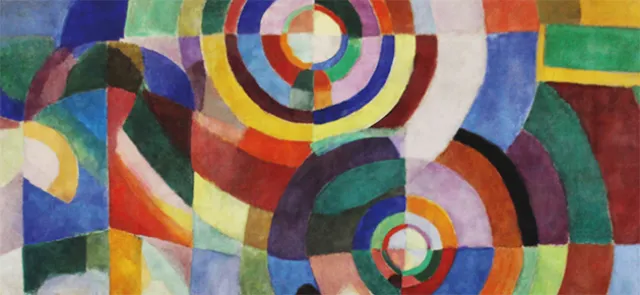
Jacques Dominioni then embarked on Cubist explorations, producing paintings of geometric forms in pure, contrasting colors.
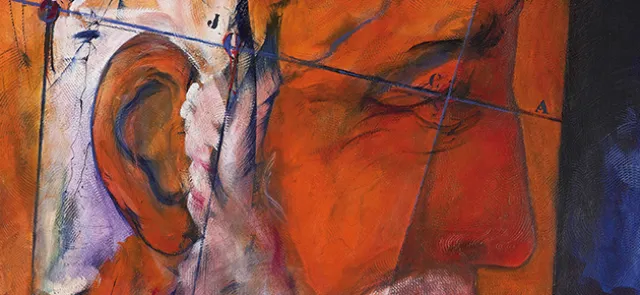
Around 1995, the human body, depicted in a lyrical style, began to appear in his work. Nude bodies now filled the canvas, lines broke apart, dynamic curves emerged, and his palette tended towards monochrome through the use of two complementary colors. The message was powerful: the painter asked himself—and challenged the viewer to consider—the meaning of life.
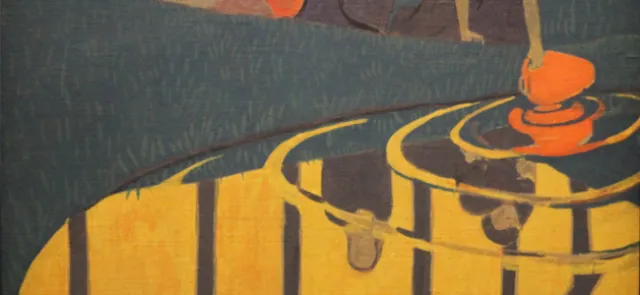
Unaffiliated with fashions or artistic movements, Jacques Dominioni based his explorations on pictorial construction. His work recalled the post-Cubist period, at times free and impetuous, with a lucid, uncompromising realism.
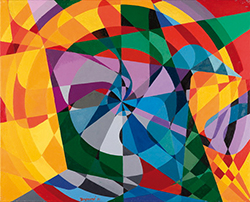
Oil on canvas (100 cm × 80 cm), featured on the cover. Jacques Dominioni, 1990.
Available for purchase at .