From the coast of Peru and northern Chile to the Bolivian and Peruvian highlands, weavers share a method of arranging threads across the surface of the cloth by counting them according to different rhythms. This method affects not only the texture or surface quality of the fabric, but also the construction—and therefore the shapes—of the patterns.
Like all woven fabrics, Andean textiles are made from warp threads, stretched on a loom, and weft threads, which are gradually passed at right angles between the warp threads, from bottom to top. A basic Andean loom has a row of heddles and a shed rod that separate the odd- and even-numbered threads (see diagram below). Weavers do their counting where these two groups of threads intersect.
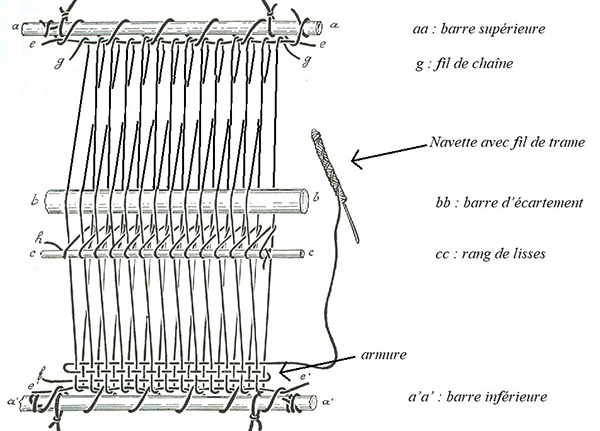
Basic weave structures
-------------------
On such a loom, the simplest weave structure—that is, the interlacing of the warp and weft threads—is plain weave, in which the weft passes alternately under the odd-numbered warp threads in one direction and under the even-numbered ones on the return pass.