-
Born on April 23, 1935, Marcia Alper Ascher grew up in New York City, in the borough of Queens—more precisely, in the Middle Village neighborhood. Gifted at mathematics from an early age, she was taken out of primary school to attend a New York school for gifted students. She continued her studies at Queens College, part of the City University of New York (often abbreviated to CUNY), where she met her future husband, Robert Ascher.
In 1956, they both moved to the University of California, Los Angeles, where Marcia earned a master's degree in mathematics. In 1960, Robert took up a position in anthropology at the prestigious Cornell University. Marcia joined the mathematics department at Ithaca College, which she helped establish.
####
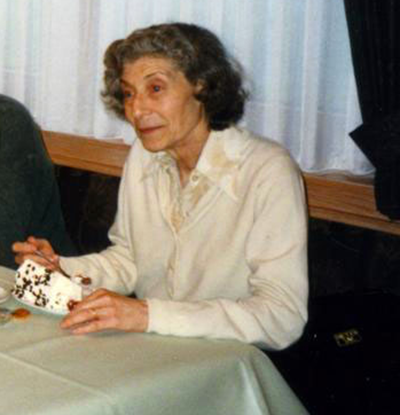
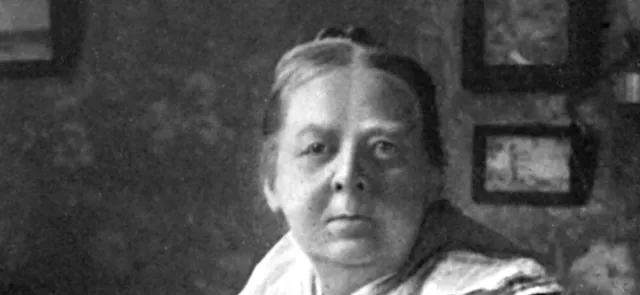
Marcia Ascher in 1996.
She worked there until retiring in 1995 and died in 2013, a few months before her husband. Together, they combined mathematics and anthropology in their study of mathematical questions (as early as 1963, they published an article entitled *Chronological Ordering by Computer), and later explored, among other subjects, quipus*. Following this early joint research, Marcia pursued ethnomathematics independently, most notably producing two books now regarded as central to the field.
A foundational book
------------------
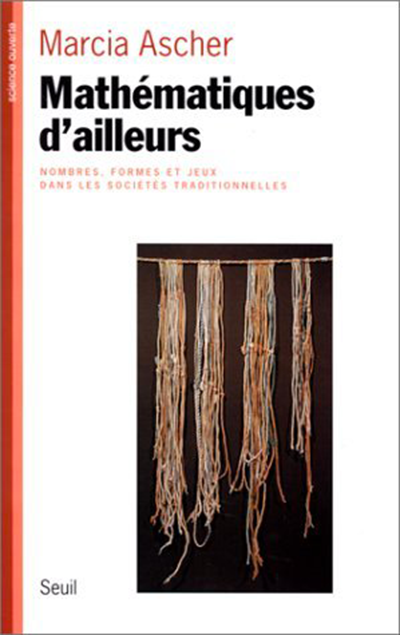
In Ethnomathematics. A Multicultural View of Mathematical Ideas, published in 1991 (Mathématiques d’ailleurs. Seuil, 1998),
Marcia Ascher explores mathematical ideas outside Western cultures. She examines the Inuit, Navajo and Iroquois of North America; the Inca of South America; the Malekula, Warlpiri, Māori and inhabitants of the Caroline Islands in Oceania; and the Chokwe, Bushoong and Kpelle of Africa.
One of her key concerns is to show that a culture cannot be judged by its level of mathematical advancement, which Westerners often picture as a straight line along which cultures lie at different points. On the contrary, mathematics takes many forms and cannot always be compared from one culture to another, just as one could not say that one body of literature is more "advanced" than another.
She describes numbers, their names and representations, and shows how different cultures have approached a range of topics: problems related to Eulerian graphs, using their own concepts and approaches; complex kinship systems that can be studied through group theory; games of strategy and chance; and the organization of space and time.
The universality of mathematics
--------------------------------
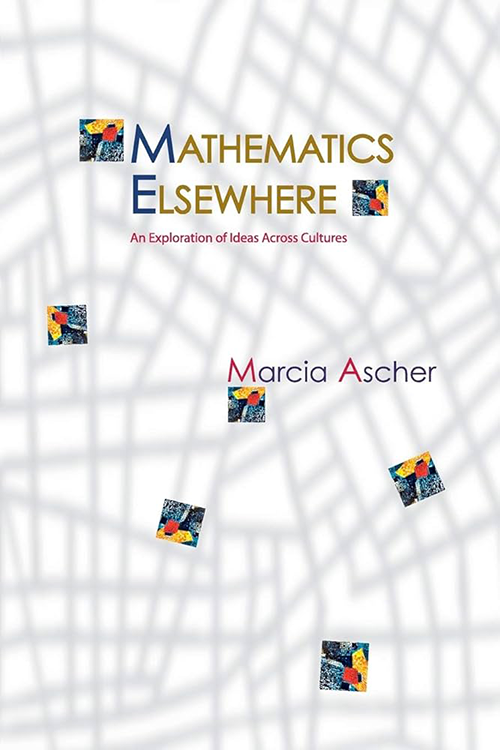
Published in 2002, Mathematics Elsewhere. An Exploration of Ideas Across Cultures builds on the previous book by examining additional cultures. It opens with a discussion of the logic of divination in three different cultures and the randomization processes that underlie it. What interests the author here are the highly complex mathematical mechanisms used to create randomness. She then turns to time and calendar-related questions. One striking chapter concerns the charts used by sailors from the Marshall Islands.
These various examples are intended to demonstrate the universality of mathematical thought and emphasize that people have always "mathematized" and acted as "mathematicians," pursuing their ideas far beyond the solutions to their original problems.