The mathematical field of combinatorics on words emerged at the beginning of the 20th century and studies sequences of symbols known as words over an alphabet. One of the field's foundational papers was written by the Norwegian mathematician Axel Thue (1863–1922), who described how to construct an infinite word over two letters containing no cube—that is, no pattern repeated three times in succession, such as (aba)(aba)(aba). Theoretical computer science and mathematical linguistics considerably spurred the development of this line of thought, and the leading reference works on the subject were written by a group of researchers called Lothaire, whose members included former students of the French mathematician Marcel-Paul Schützenberger (1920–1996).
The concept of a word over an abstract alphabet is well suited to describing a succession of events within a musical sequence. It allows certain properties found in music to be stated and clarified precisely. It can be applied to scales, which are sequences of notes ascending from low to high. It can also be applied to rhythms, which are sequences of durations that can be expressed in terms of a reference duration such as an eighth note. For example, the rhythm 332 corresponds to the sequence dotted quarter note, dotted quarter note, quarter note. Finally, in computer music, it can be used in systems that generate music automatically, where representing musical sequences as words over an alphabet lends itself to computational processing. When the music under study belongs to oral traditions far removed from the Western tradition, describing it through concepts from combinatorics on words falls within the scope of ethnomathematics. Whether the mathematical models used in these descriptions are relevant from an Indigenous perspective is a major issue in ethnomathematical thought, to which we will return later.
Asymmetric rhythms
------------------------
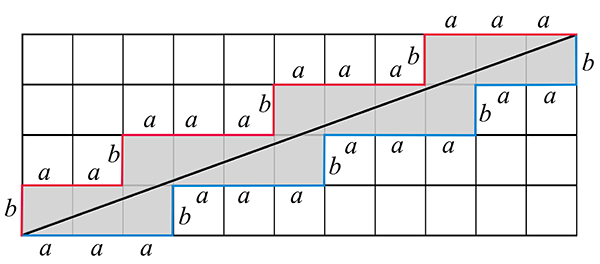
Many asymmetric rhythms are found in Africa. They sound close to a regular sequence of pulses, but some of the intervals between those pulses break the regularity, creating an asymmetry. This is true of the rhythm 332 mentioned above, in which the 2 breaks the regularity of the two consecutive 3s. Combinatorics on words offers a powerful concept describing a similar phenomenon: the Christoffel word. It originated in the representation of a line as a sequence of pixels—that is, a staircase made up of elementary horizontal and vertical moves that approximates the straight line as closely as possible (see below).