The Celts were a collection of societies sharing a common cultural identity. They inhabited much of Europe, from the British Isles to the Iberian Peninsula and as far east as Turkey, over a period extending from the Iron Age to the Romanization of Gaul, and into the early Middle Ages in Ireland and the United Kingdom. These peoples left few written records, preferring to transmit their knowledge orally, and chiefly developed their art on utilitarian objects—pottery, weapons and jewelry—rather than on monuments like the Romans and Greeks.
Their art is intended to be intimate and subtle. Its finely crafted patterns were designed to be viewed up close by the owners of the objects they adorned. The resulting decoration is stylized, largely nonfigurative and extremely geometric.
This intrinsic geometry makes it possible to create complex, interwoven and exuberant decoration, teeming with layers of meaning and hidden details, without compromising the overall aesthetic. This is where geometrization—the act of "making geometric"—comes into play. The patterns are organized according to sophisticated geometric principles and follow a logic that allows them to form coherent designs. This geometrization can be studied through ethnomathematics.
Structural continuity
-------------------------
Decorated bands are a good example of the geometric organization found in Celtic art. Marcia Ascher explains the principle behind them in her book Mathématiques d’ailleurs (Seuil, 1998), which has become a standard work in ethnomathematics. It involves classifying decoration arranged in bands, or friezes, according to the translations, rotations and reflections of a single pattern. There are seven types of organization, known as isometries, which Celtic societies had already mastered perfectly by the end of the Hallstatt period—the Early Iron Age, 650 BCE—particularly on pottery. Decorated bands subsequently appeared throughout the continental Iron Age, for example on sword scabbards, whose shape lends itself particularly well to such decoration, and continued into the early Middle Ages in the British Isles, in illuminated manuscripts. All types of isometry are attested across all these media.
More than the variety of media, it is the persistence of this type of decoration across centuries, geographical regions and artistic styles that reveals an underlying structural continuity. This points to a distinctive mathematical way of thinking that defines Celtic art just as much as its choice of patterns. A PMM2 decorated-band design, with vertical and horizontal symmetry, can therefore appear in a "geometric" style composed of so-called "simple" shapes on pottery, in an exuberant Irish style filled with plant-like micro-patterns on a sword scabbard, and in the intricate interlace of illuminated manuscripts from the medieval British Isles.
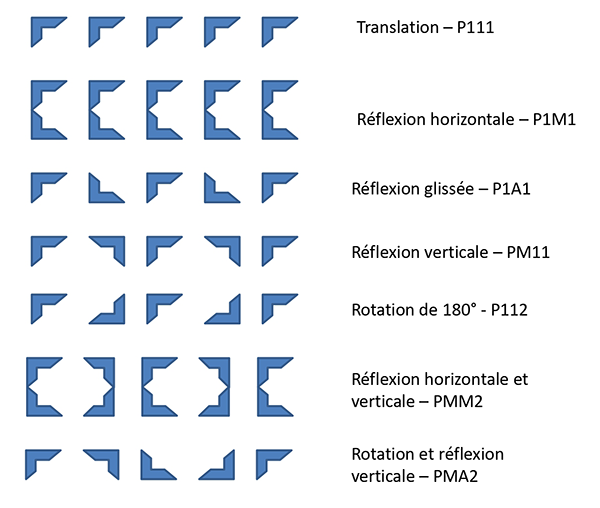
Isometries in Celtic decorated bands.
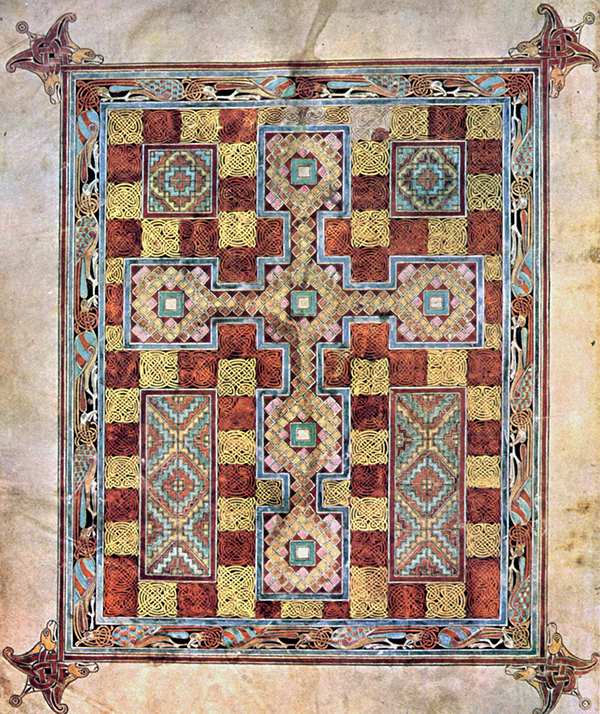
Lindisfarne Gospels (18th century). P111 decorated bands (simple translation) in the bird friezes and P4M tilings (a square with full symmetry) in the side panels of the cross.
A theory developed after the fact
-----------------------------
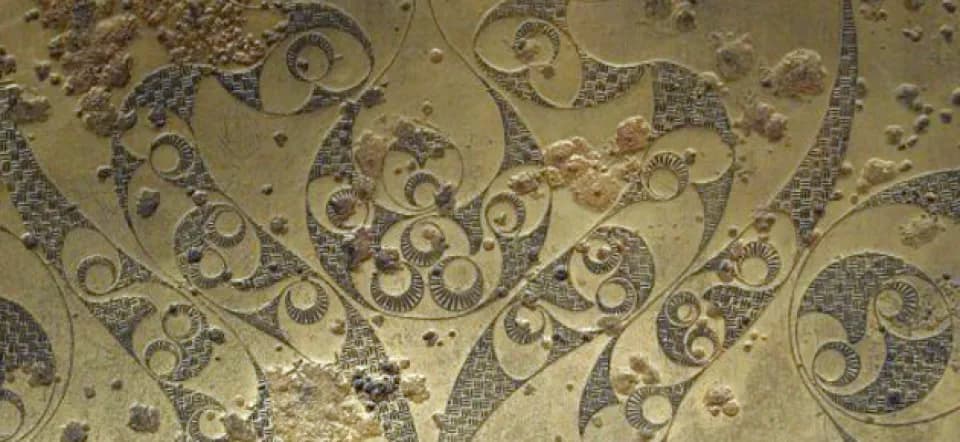
Decorated bands are not the only geometric feature that can be analyzed in the art of Celtic societies. Pythagorean principles have been identified on phalerae—chariot ornaments—whose openwork metal mesh, meticulously fashioned from intersecting circular arcs, demonstrates a thorough understanding of circles and their subdivisions.
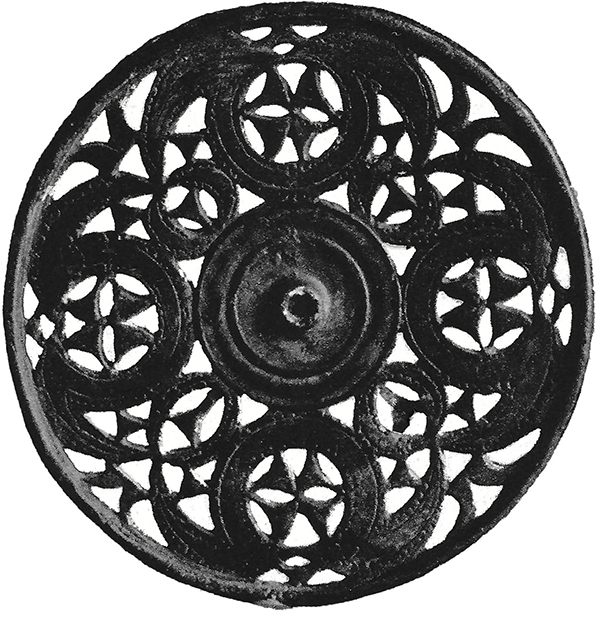
An example of dividing up a circle: the Somme-Bionne phalera.
Other principles are also employed, including tilings. Although later examples can be found, such as the decoration of the Alhambra in Spain, tiling itself was not formalized until much later. In the late 19th century, the Russian mathematician Evgraf Stepanovich Fedorov (1853–1919) notably proved that there are 17 types of tiling, while their artistic potential was made famous in the 20th century by the artist Maurits Cornelis Escher. Their presence in illuminated manuscripts is not merely a happy artistic accident: their recurrence and diversity show that artists genuinely explored the forms and possibilities—both artistic and geometric—offered by this type of decoration.
Other decoration displays fractal constructions, themselves not theorized until the 20th century, repeating patterns within the physical limits imposed by the medium. Whether in decorated bands, tilings or fractals, Celtic geometric constructions reveal a desire to break free from their medium and exist beyond what the human eye can perceive.
The quest for movement
-------------------------
At first glance, Celtic art is striking for the sense of dynamism and vitality conveyed by compositions that are nevertheless largely nonfigurative. This effect is achieved not only by breaking free from the boundaries of the medium, but also by creating depth through visual effects and multiple readings between pattern and background. The object bearing the patterns becomes a key element of its own decoration. This is particularly true of mirrors, whose very shape creates a fractal mise en abyme, while the patterns filling that shape create an interplay between those drawn in the foreground and those emerging from the background. Moreover, these two types of pattern recur at different scales and contain hidden figurative elements in the form of birds’ heads.
####
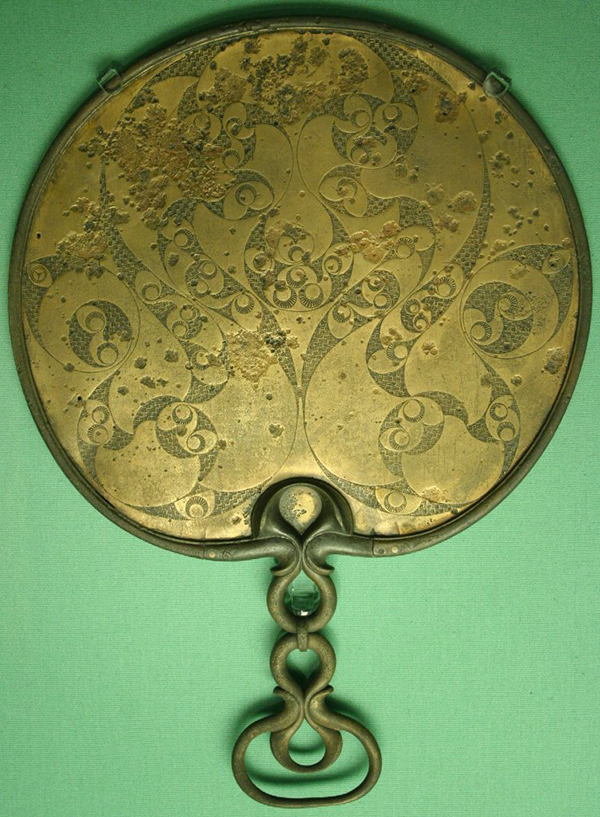
Desborough mirror (Great Britain;
1st century BCE–1st century CE).
Interplay between pattern and background: multiple readings, light effects and fractal patterns.
This dual reading likewise appears throughout these compositions: it can produce a second type of decorated band in the background of a frieze, reveal triangular compositions between the arcs of circles on phalerae, and offer a wider repertoire of shapes on mirrors.
This combination of mathematical and geometric principles thus contributes to a sense of depth and movement, a principle also found in manuscript interlace. The strands forming the interlace pass alternately over and under one another, revealing a search for a sense of relief and depth—an exploration of the third dimension—while the pattern’s repetition creates a rhythm suggesting that it could continue beyond the boundaries imposed by the object.
Masters of knowledge
----------------------
These artistic creations seem to attest to a thorough knowledge of the mathematical and geometric principles involved. The resulting shapes and patterns are not products of chance, but of reasoning that takes into account the mechanical properties of the object that bears them, the limits of the surface available for decoration, their intrinsic symbolism and the intended effect on the observer. This raises the question of access to some form of mathematical and geometric education.
The repetition of patterns in decorated bands or manuscript tilings—what Mary Carruthers calls "memorative composition" in her book Le livre de la mémoire (Macula, 2018)—through its rhythmic arrangement, fosters a mental state conducive to memorizing the sacred texts associated with the illuminations. This double reading, meanwhile, reflects a release from the constraints of the medium; on mirrors, it also allows light to play across the metal surface, giving these patterns a further sense of life.
Phalerae were fitted to chariots and horse harnesses, while scabbards and pottery were handled and manuscript pages were turned. With their many layers of meaning and viewing angles, these designs therefore show an awareness of how the objects would be used and examined from several perspectives. They come alive in the hands of the observer: a life governed by mathematical and geometric principles and expressed through complex formal vocabularies.