For guitarists, Al Hamra, Granada's red citadel, remains associated with a magnificent tremolo study—a true masterpiece of late Romanticism—that brought fame to the Spanish composer Francesco Tarrega. His Souvenirs de l'Alhambra, elevated by Alexandre Lagoya's rapturous interpretation, is an essential work in the guitar repertoire.
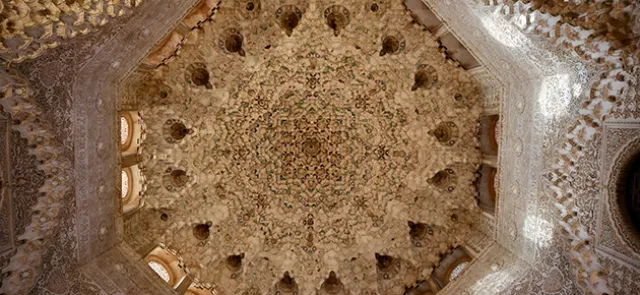
For mathematicians, the astonishing, almost exhaustive variety of geometric decorative patterns found there makes it a source of wonder and admiration. A wallpaper group, also known as a crystallographic group, is a group (in the mathematical sense) consisting of all the symmetries of a periodic two-dimensional pattern that can cover the plane indefinitely through translations in two nonparallel directions. We now know that there are seventeen wallpaper groups (see later in this feature), making it possible to classify all periodic two-dimensional patterns. This result dates from the late 19th century. What is astonishing, however, is that all seventeen groups occur in the azulejos (decorated ceramic tiles) adorning the Alhambra, an architectural complex built in the 14th century by the kings Yusuf Ist and Mohammed V al-Ghanî. In practice, however, deciphering, recognizing and identifying all the different patterns adorning the walls and floors of the various buildings and gardens that make up the palace complex proved far from straightforward…
-
No Alhambra, no Escher!
-----------------------------
A first mathematical study of various types of decorative structures in the plane, based on a sample of tilings from several cultures, was conducted by the Hungarian-American mathematician György Pólya (1887–1985). His research, published in 1924 in the German journal Zeitschrift für Kristallographie, provides a mathematical classification and a comprehensive visual representation of the seventeen plane symmetry groups. Although the Russian mathematician Evgraf Stepanovich Fedorov (1853–1919) had already established this result in 1891, Pólya's article is said to have helped inspire the extraordinary output of the Dutch artist Maurits Cornelis Escher (1898–1972), who discovered it in the early 1930s and made every one of the mathematician's graphic examples his own. Escher had also known the Alhambra for ten years when he discovered Pólya's research. He had admired its decorative elements and had written at the time: "After my visit in 1922, I became increasingly intrigued by combinations of figures whose appearance suggests to the observer an association with objects or living beings." Here the artist explicitly acknowledges the influence of Andalusian craftsmen on his entire body of work. No Alhambra, no Escher!