



Tilings of the plane
Regular tilings and friezes are now rigorously catalogued, but their diversity far exceeds initial intuition. In the 20th century, group theory indeed put an end to their apparent variety, thanks to the introduction of notations both clever and powerful. The subject seemed barely closed when non-regular tilings were discovered! Mathematician Roger Penrose and engraver Maurits Cornelis Escher were the precursors of these astonishing and magnificent new mosaics... whose riches Muslim artists had already glimpsed!
All articles in this folder
A first overview
Tiling began as a practical idea. Roads and houses were paved long before anyone saw mathematics in them! Since then, the concept has been extended, and today even non-Euclidean and four-dimensional spaces are tiled…
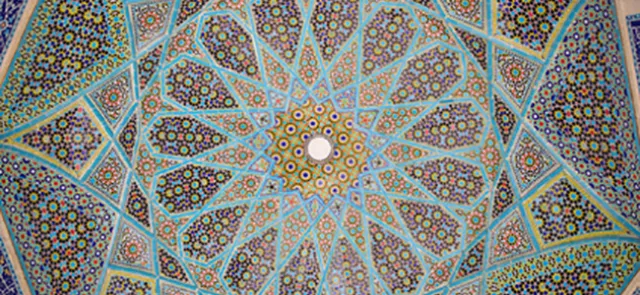
The secret of patterns in the Islamic world
The tilings and interlaced designs of medieval Islamic art command our admiration. But could a few simple geometric shapes lie behind this apparent complexity of line segments, interlacing, nested curves and polygons?
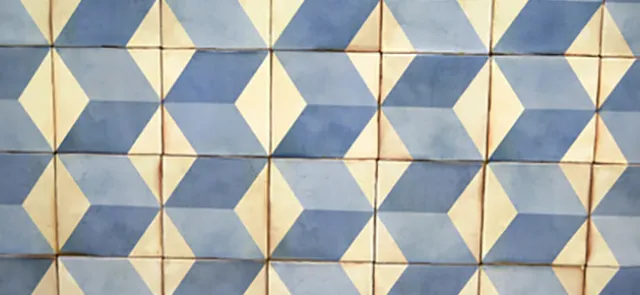
Signature and the tiling theorem | Tangente
Have you ever noticed? In friezes, tilings and other periodic patterns that repeat or exhibit symmetries, the artist's range of possibilities is actually quite limited. A fundamental theorem provides a complete enumeration of these patterns.

Rep-tiles | Tangente
The self-similarity requirement has led to many interesting results on tilings
Seventeen groups that tile the plane
The plane tiling theorem states that the weight of a motif must equal 2. This small value makes it possible to consider every possible wallpaper symmetry: there are only seventeen wallpaper groups.

The mosaics of the Alhambra in Granada
The decorative patterns of the Alhambra in Granada, a fortress built in the 14th century, encompass all the symmetry groups of plane tilings that can be repeated using two nonparallel translations. But this finding is recent, incomplete and somewhat controversial...
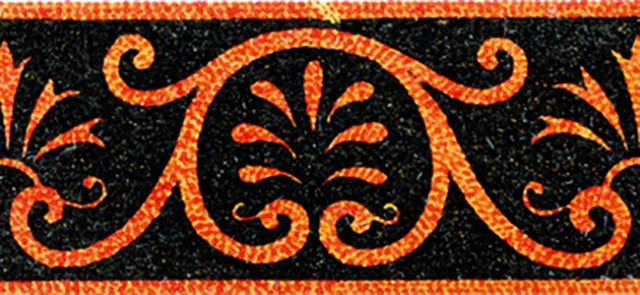
The seven types of frieze | Tangente
A tiling covers the plane, extending infinitely in two dimensions; a frieze extends in just one direction. The quintessential decorative motif, it is the decorative border you can put above your wallpaper. There can be only seven different types.