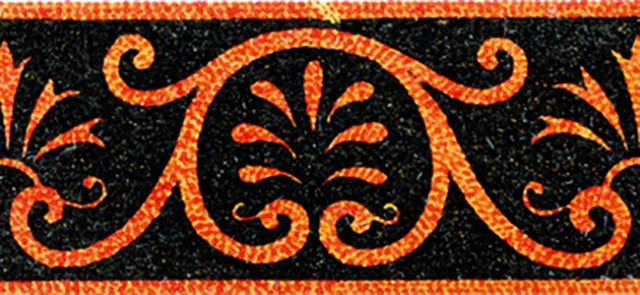
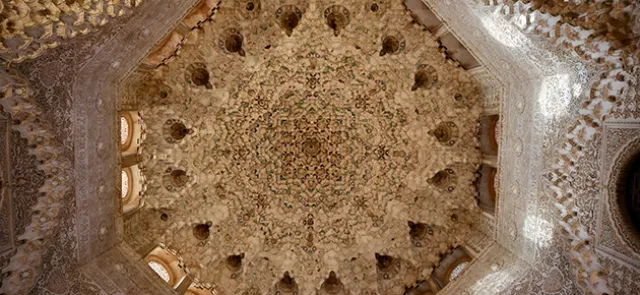
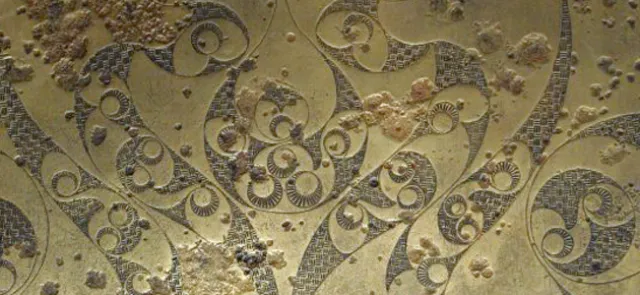
How can we describe a figure's symmetry? To do so, we need a mathematical language. One of the best known, renowned for its effectiveness, was pioneered by Alexander Murray MacBeath (1923–2014), then adapted by William Thurston (1946–2012) and John Horton Conway (born 1937).
Here, "symmetry" means more than reflection in a line or a point. We use the word whenever one part of a figure can be matched to another at the same scale (the transformation involved is an isometry, a bijection that preserves distances). The Greek term syn means "same", while metry means "measure".
Once all the symmetries of a figure are known, the entire figure can be reconstructed simply by applying them to the original motif. Here, we consider only isometries: orientation-preserving or orientation-reversing isometries, namely point reflections, reflections in a line, rotations, and their compositions.
-
Mirror, mirror on the wall…
------------------------