



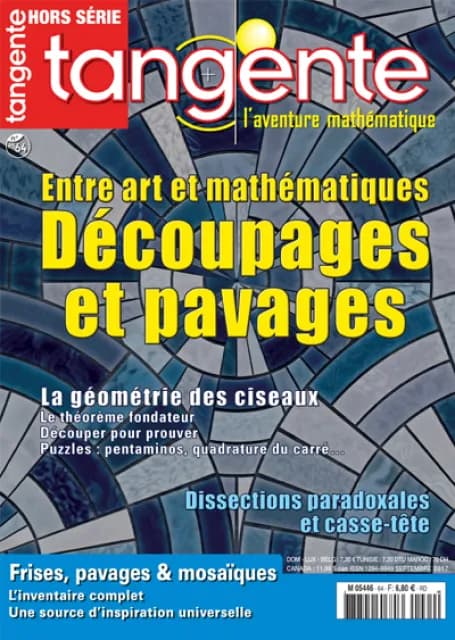
Dissections and Tilings
This issue is not fully translated into English yet; only translated content is shown.
Read the French versionAll folders in this issue

Dissections
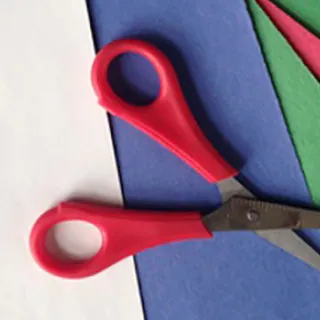
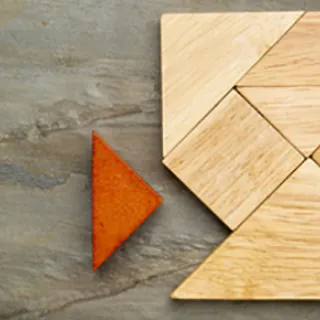
Recreations around geometric dissections (or dissections) are found in all civilizations. Squares, rectangles, polygons and, for about fifty years, polyominoes, provide an inexhaustible mine of puzzles whose elegance often lies in their simplicity. This area of geometry also holds real mathematical questions: can two figures of the same area be obtained, one from the other, using a simple pair of scissors? A theorem answers the question.

Tilings of the plane
Regular tilings and friezes are now rigorously catalogued, but their diversity far exceeds initial intuition. In the 20th century, group theory indeed put an end to their apparent variety, thanks to the introduction of notations both clever and powerful. The subject seemed barely closed when non-regular tilings were discovered! Mathematician Roger Penrose and engraver Maurits Cornelis Escher were the precursors of these astonishing and magnificent new mosaics... whose riches Muslim artists had already glimpsed!

All articles in this issue

The world of "puzzlers" 1
Cuts, dissections and cunning assemblies give rise to extraordinary mechanical puzzles. A remarkable annual convention is devoted to them.

The Stomachion, the world's oldest puzzle!
The Stomachion is certainly the world's oldest puzzle. It owes its fame not only to Archimedes' interest in it, but also to the extraordinary circumstances in which the Syracusan's writings, lost for two thousand years, were recovered…

Pentominoes
Let's rediscover pentominoes and the countless problems they generate

The world of "puzzlers" 2
Among the best-known mechanical puzzles are wooden knot puzzles, which the American Bill Cutler analyzed scientifically.

The world of puzzlers 3
The small world of puzzle enthusiasts, collectors and puzzle makers is astonishingly diverse. It includes specialists in tilings and elegant dissections.