



Dissections
Recreations around geometric dissections (or dissections) are found in all civilizations. Squares, rectangles, polygons and, for about fifty years, polyominoes, provide an inexhaustible mine of puzzles whose elegance often lies in their simplicity. This area of geometry also holds real mathematical questions: can two figures of the same area be obtained, one from the other, using a simple pair of scissors? A theorem answers the question.
All articles in this folder
The geometry of scissors
Dissections are an inexhaustible source of research, discoveries and feats for amateur geometers and seasoned mathematicians alike. Born of practical concerns, they have become a treasure trove of mathematical recreations and brainteasers.
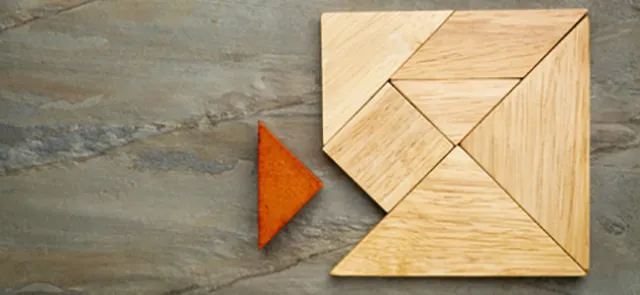
Four authors for one theorem | Tangente
A tangram consists of seven polygonal pieces that can be assembled to form a given shape. But what about the inverse problem? When can two figures be solutions to the same puzzle? When do they admit the same dissection into elementary shapes? A famous theorem answers that question completely.

Dissecting the square, from Abu al-Wafa to Dudeney
Cutting a given square into identical squares seems easy at first glance—and produces beautiful mosaics. But is it really that simple? What if, instead of identical squares, we require them all to be different, creating ingenious puzzles? A rich geometric world opens up…

Squaring the square | Tangente
The search for perfect squared squares has inspired many attempts, some of them very elegant.

Proofs without words
Proofs without words are figures that visually illustrate algebraic relations, some of them fairly complex.

The art of Harry Lindgren | Tangente
A math enthusiast passionate about geometric dissections introduced powerful methods that remain classics today.

Puzzles: useful resources | Tangente

Dissections: Greg Frederickson's trilogy | Tangente
Greg Frederickson's trilogy is regarded as THE definitive reference on geometric dissections.

Dissecting an obtuse triangle | Tangente
The problem of dissecting an obtuse triangle was proposed by Martin Gardner in Scientific American.
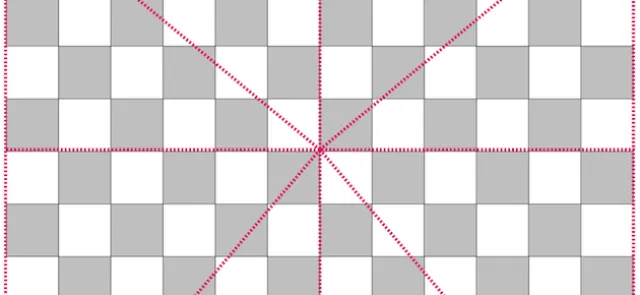
Paradoxes in the world of dissections | Tangente
Tilings and geometric dissections gave rise to equidissection puzzles, which have kept our brains buzzing since the 18th century.