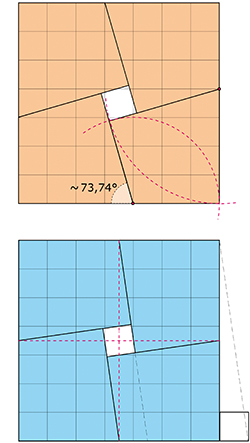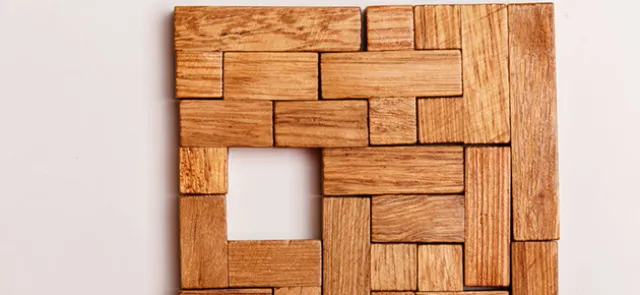
Geometric dissection puzzles, whether made of wood, foam or heavy card, can be valuable teaching aids. Their defining feature is their counterintuitive nature. Students and recreational mathematics enthusiasts particularly enjoy dissections that prove deceptively simple or contain very few pieces, creating the illusion that they will be easy to solve. During the solving process, this apparent simplicity exposes certain mental blocks or mental habits. Puzzle designers aim to create a "disconnect" in the player's mind—an "expectation violation" that spurs them on, encourages them to think free of preconceptions and takes them off the beaten track.
-
The false twins
---------------
Although both puzzles below begin as squares of the same dimensions with identical holes, the slight difference in the angle at which their pieces are cut is enough to produce some surprises... A close look at the pieces of the first puzzle (the orange diagram) reveals that they are not irregular, as one might think: one of their diagonals is actually an axis of symmetry.