
From 1957 to 1980, Martin Gardner (1914–2010) wrote the mathematical games column for Scientific American (whose French edition is Pour La Science). He posed a triangle dissection problem that perfectly reflected his fondness for puzzles that look complicated but yield to one bright idea: can an obtuse triangle (one with an obtuse angle) be dissected into a finite number of acute triangles (whose angles are all acute)? The answer is yes—with seven triangles, to be precise.
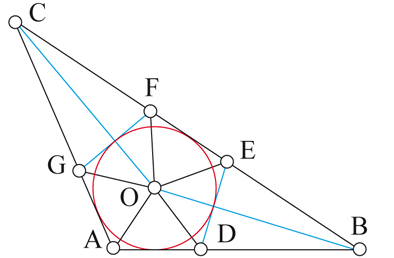
Suppose the triangle ABC is obtuse at A. Consider the incircle of ABC, with center O at the intersection of the triangle's three angle bisectors. Draw the tangents (DE) and (FG) to the circle, perpendicular to (BO) and (CO), respectively, so that triangles BDE and CFG are isosceles. Let 4a, 4b, and 4c be the angles at A, B, and C in degrees (so that a + b + c = 45°). We determine the angles of the seven triangles CGF, BDE, OAD, ODE, OEF, OFG, and OGA using two facts: the angles of a triangle sum to 180°; and the tangents (AD) and (AG) to the circle make equal angles with (AO), as do the other tangents. This gives the following values (in degrees):
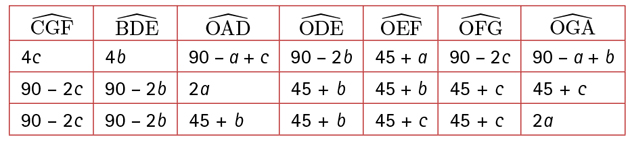
All these angles are acute! Moreover, seven is the minimum possible: the obtuse angle at A must be subdivided by a side of one of the triangles, and that side cannot end on [BC], since this would create another obtuse angle that would itself have to be subdivided, and so on. It must therefore end at an interior point of the triangle. At least five sides must meet there if all the angles are to be acute. This forces a pentagon inside the triangle, and hence seven triangles.