In search of perfection…
------------------------------------
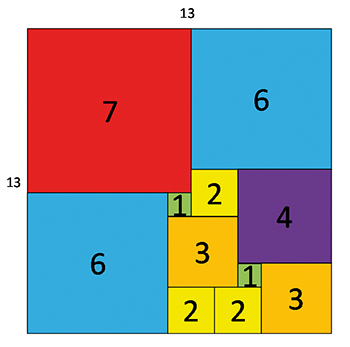
The American Samuel Loyd (1841–1911) was Dudeney's rival. In a puzzle titled "Mr. Perkin's Kilt", he proposed the following dissection, which is not perfect since some integers are repeated.
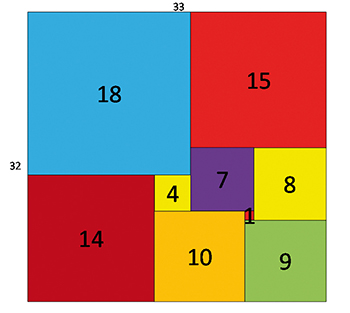
In 1925, the Polish mathematician Zbigniew Moro? (1904–1971) published a dissection of a rectangle (almost square, with dimensions 33 by 32) into nine squares. In fact, he published the first simple perfect squared rectangle. In 1903, the topologist Max Dehn (1878–1952), then a student of Hilbert's, had established the following theorem: a rectangle can be squared (made up solely of squares) if, and only if, its sides are commensurable. The ratio of the side lengths must therefore be a rational number.