A field still open to amateurs
------------------------------------------
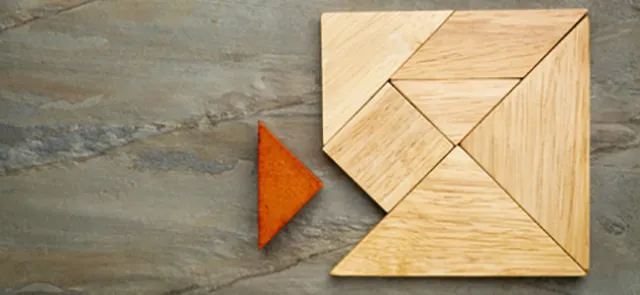
Anything is possible in the world of polygons since the German mathematician David Hilbert (1862-1943) proved the following theorem: any polygon can, after being cut into a finite number of pieces, be reassembled into any other polygon of the same area.
The proof of this result rests on the following two properties: any polygon can be triangulated (that is, divided into a finite number of triangles), and any triangle can, after being cut up, be reassembled to form a rectangle with a given base. The whole difficulty lies in being economical with the number of pieces! And we can never be absolutely certain of having reached the minimum, since it is rare that this can be proved… That is why this field is still within reach of amateurs (in the noble sense of the term). Harry Lindgren was one of them.
-
Dissections: as complete an inventory as possible
-----------------------------------------------------