Sums of integers in pictures
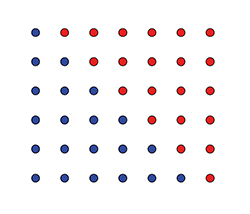
Visual arrangements of points lend themselves wonderfully to illustrating the variety of proofs without words (see the review above). The following arrangement, for example, popularized by Martin Gardner, illustrates that the sum of the first n integers equals n (n + 1) / 2.
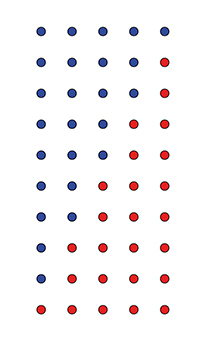
Another classic was made famous by John Horton Conway and Richard Kenneth Guy (The Book of Numbers, Eyrolles, 1998). This is the visual proof that the sum of the first n odd integers equals n2.
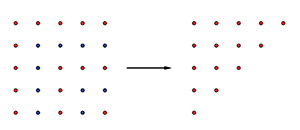
Finally, as recounted in Roger Nelsen's book, the alternating sum of squares of integers can be expressed algebraically as follows:
This equality can be translated visually into the following charming picture, due to the American mathematician Steven Snover:
-
The sum of triangular numbers
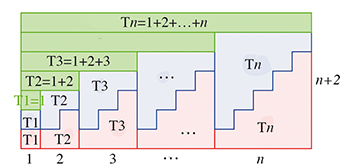
Roger Nelsen recounts a fine tiling exercise in the book mentioned above. It is due to the ingenuity of Monte Zerger, a retired American mathematician, and invites us to revisit the classic equality concerning the sum of the first n integers. Except that in this interpretation, the formula invites us to think about the sum of the first n triangular numbers (that is, of the form k (k + 1) / 2, with k an integer).
-
Visual delight and mathematical reflection
"Proofs without words" are, the author tells us, "figures, schematics, or diagrams that help the reader understand why a particular mathematical statement may be true, as well as see how one might attempt to prove it". To the sceptics who say that a "visual proof" is not a proof, this book shows that Roger Bain Nelsen's visual proofs all have the merit of making the reader think… and sometimes at length, and of pointing the way toward a genuine proof. The latter can be achieved, in the case of geometric proofs, by dissection and reassembly, or, in the case of algebraic proofs, by a calculation tied to the picture. Care must be taken, however, to correctly interpret the notation in the pictures, which is not always very clearly laid out!
Two striking phenomena stand out: the sheer number of proofs presented (more than two hundred and thirty), and the variety of fields covered: geometry (with, for example, thirteen Pythagoras puzzles) and algebra, trigonometry, analytic geometry, differential and integral calculus, a great many inequalities, combinatorics and sums of integers, sequences and series, and even a few topics in linear algebra. This book thus offers a broad range of subjects providing material for fine exercises, for pupils, students, and curious amateurs of visual delight alike.
#### *
*
Proofs without Words. Roger Nelsen,
Hermann, 278 pages, 2013, 30 euros.