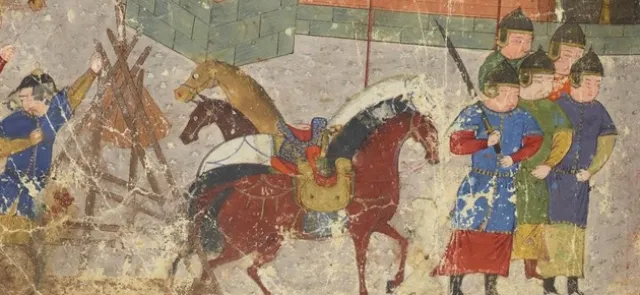
The manuscripts of antiquity survived only through repeated copying, and their preservation owed much to the transition from the papyrus scroll to the codex (a stack of parchment leaves). Parchment was so precious that it was customary to recover it from works regarded as minor: the old text was scraped away, and the parchment was then reused to copy a work considered important.
-
Codex C decoded
------------------
Most of Archimedes' writings are known to us through his correspondence with scholars in Alexandria, including Eratosthenes, Conon and Dositheus. After the Library of Alexandria was destroyed, some writings survived in Constantinople. Codices containing Archimedes' treatises were compiled under Isidore of Miletus (6th century) and Leo the Geometer (9th century). Two of them, catalogued as A and B, were translated from Greek into Latin for the Vatican in 1269. Codex B disappeared from the record in 1311. Still owned by Pope Nicholas V in 1450, Codex A was copied at the request of Lorenzo de' Medici, passed into the Pio family and disappeared in 1564.
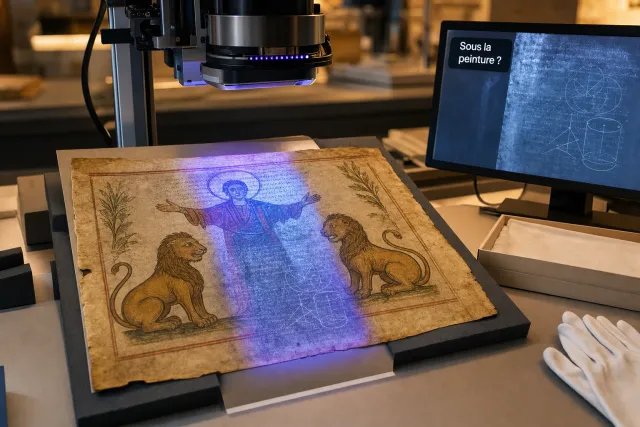
Codex C, copied in Constantinople in the 10th century, was converted into a prayer book around 1229. Its double-page sheets were detached, scraped, stripped and sanded, then cut in half and rotated through 90 degrees (to prevent the raised traces of the old writing from getting in the way), forming the folios of a 177-page palimpsest half the original size. Entrusted to the Mar Saba Monastery near Bethlehem, it resurfaced around 1840 at the Metochion of the Holy Sepulchre in Constantinople. In 1906, the Danish philologist Johan Heiberg studied the document from photographs he had taken, just before the Codex disappeared. In 1915, he published a completely new edition of Archimedes' works by combining Codices A, B and C, bringing The Method and the Stomachion into print for the first time; both had survived only in Codex C.
After many twists and turns during the 20th century, which inflicted more damage on it than all the preceding centuries combined, Codex C resurfaced in a sorry state at an auction in 1998! A mysterious buyer entrusted the document to the Walters Art Museum in Baltimore to restore it and finally reveal to us the last works of one of humanity's greatest thinkers.
Fortunately, the text had not been completely erased: through painstaking work, Heiberg managed to decipher 80% of it using daylight alone. But the sections concealed by the binding remained beyond his reach. Since then, cutting-edge imaging techniques, combined with sophisticated signal processing, have been used to analyze this unique document. Examination under ultraviolet light revealed new texts in 2005. In 2006, X-ray analysis using Stanford University's synchrotron revealed traces of the iron contained in the original ink.
Codex C thus provides the only known copies of the Stomachion, a combinatorial puzzle that predates the Tangram by two thousand years, and The Method, in which Archimedes explains his integration technique, as well as the only Greek copy of On Floating Bodies.
-
Archimedes' puzzle
---------------------
A new treatise begins on a single bifolium after the treatise on the measurement of the circle. Its barely legible title, Stomachion, was followed by a few introductory words, one proposition and the beginning of a second. This is all that remains of the original mathematical content. If the other leaves were discarded, it was almost certainly because the Stomachion was the final treatise in the original manuscript; its pages must therefore have been too badly damaged to be scraped and recycled into the palimpsest.
In 1899, the second fragment of the Stomachion was discovered in an Arabic manuscript by the Orientalist Heinrich Suter. Unfortunately, translations into Arabic made in Baghdad were often unreliable, and this document provides little information beyond confirming the diagram of Archimedes' puzzle.
The Stomachion is a game resembling the Tangram. It consists of fourteen polygonal pieces, mostly triangles, that fill a 12 × 12 square grid. The aim is to reconstruct the square after removing and shuffling the pieces.
But where does this strange name come from? Two etymologies compete: either óστεον óstéon (bone) and μαχι makhi (battle), hence "the battle of the bones," or óστομαχιον stomachein (stomach), meaning "to have a stomach ache" (from trying to solve it).
The game has left traces throughout history. The 4th-century poet Ausonius, for example, mentions the Stomachion in his Cento nuptialis, while grammarians of the late imperial period compared the number of expressions that could be formed from a few words with the infinite variety of figures—a bird, a soldier, an elephant and so on—that could be made from the pieces of this puzzle. But to understand why the Stomachion merited study, we need only read Archimedes' introduction:
> "Since the game called Stomachion provides a varied subject for studying the rearrangement of its component figures, I considered it necessary first to discuss [the different parts] into which it is divided and the figures to which each part may be compared. I have also indicated pairs of angles that [make two right angles], in order to determine the arrangements of figures formed from these parts—whether their visible sides are aligned or deviate slightly from alignment without its being apparent. Arrangements of this sort call for skill, and if the sides deviate slightly without the eye detecting it, the resulting figures need not be rejected."
After observing that two figures can combine to form another, Archimedes speaks a little later of transposition.
Once again, Archimedes was ahead of his time: in this treatise, he set out to study the different ways in which the puzzle pieces could be combined. There are 536 solutions when all the pieces are treated as distinct and rotations and reflections are disregarded.
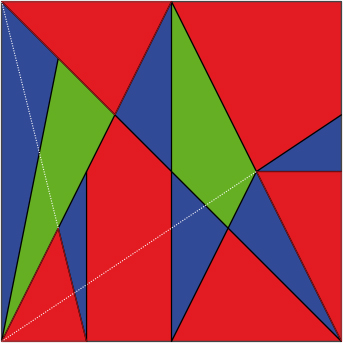
The fourteen pieces of the Stomachion.
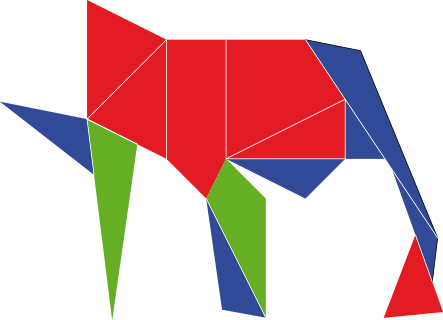
Example of a reconstructed figure (an elephant)
made from the pieces of the Stomachion.