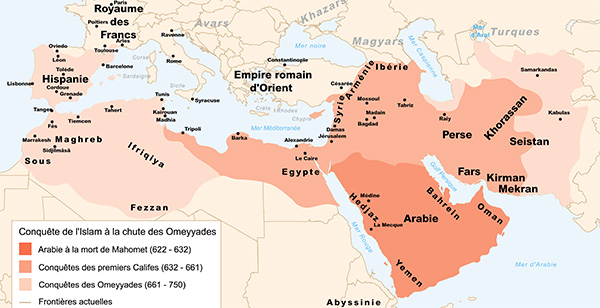
Before discussing Arabic-Islamic mathematics, we need to understand the conditions in which this entire chapter in the history of science and thought emerged and developed. That means returning to the movement from which it sprang: the expansion of Islam. When Muhammad died in 632, Islam extended across part of Arabia around Medina, its capital, and Mecca.
At the time, two great empires stood on the borders of this emerging power: the Sasanian Empire (Persia) and the Byzantine Empire (which called itself the "Roman Empire," since it was the eastern part of an empire whose western part alone had collapsed), which shared a common border. Several factors favored Islam: religious disputes in Byzantium; the so-called Plague of Justinian, which came in numerous waves from the 6th to the 8th century; and the Byzantine–Sasanian War (602–628), which enabled the Sasanian Empire to conquer Byzantine territories but left both powers exhausted; as well as political instability in Persia, where fourteen kings succeeded one another in four years. Successive caliphs ("caliph" means "successor," implicitly to Muhammad) thus managed to dominate the entire region in just a few decades (see map below). In 661, following an internal war for power, the caliphate (the entire Muslim territory) came under the control of the Umayyad dynasty, which made Damascus (in present-day Syria) its capital. The Umayyads continued their conquests as far as Spain.
####