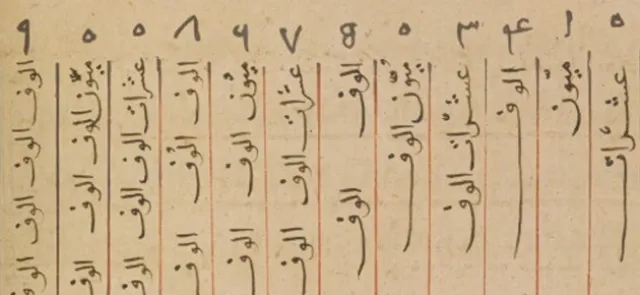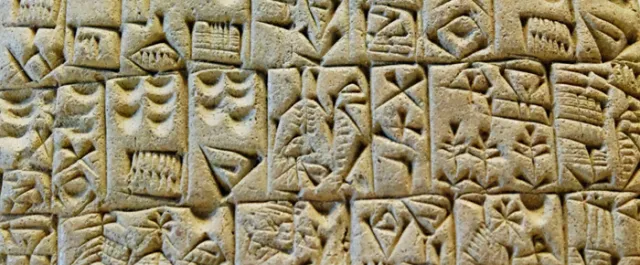
Although Indian mathematical and astronomical treatises were long written entirely in words, the earliest traces of the numerals we use today nevertheless appear in Gurjara inscriptions dating from around AD 595. The earliest known occurrence of zero in India dates from around 870 and appears in inscriptions at the Chaturbhuj Temple in Gwalior. It can also be found in the Bakhshālī manuscript, where a large dot representing zero is visible on the last line. This form was probably inherited from the notation—a circle topped by a horizontal bar—found in many Greek astronomical tables. Taken together, the fragments show how numbers were written in the manuscript, sometimes in two alternative forms.
These Indian numeral symbols, gradually modified, were carried around the world. This is why every Arab-Islamic and later Latin text discussing what we now call Arabic numerals describes them as “Indian numerals”.

Reproduction of the number 270 carved into one of the inscriptions at the Chaturbhuj Temple
in Gwalior, India, around AD 870