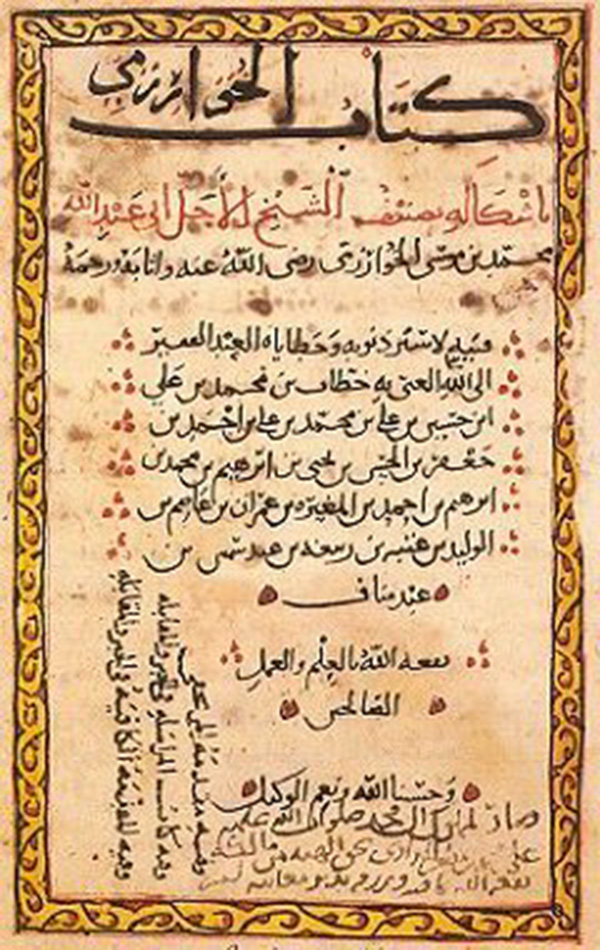
The word "algebra" comes from the Arabic al-jabr ( ), found in the title of the Kitāb al-mukhtaar fī isāb al-jabr wa-l-muqābala, written by al-Khwārizmī and often translated as The Compendious Book on Calculation by Completion and Balancing. The Arabic term al-jabr means "restoration". This operation expressed the principle of preserving balance: for example, 4x2 – 75 = x2 becomes 4x2 = x2 + 75. The term al-muqābala, meanwhile, refers to combining like quantities: 4x2 = x2 + 75 becomes 3x2 = 75.
During the Renaissance, algebra came to mean an extension of calculation methods to include negative numbers, using unknowns and parameters. Accordingly, many mathematicians wrote books bearing the word in their titles, including L’Algèbre (Algebra), by the poet and mathematician Jacques Peletier du Mans, published in 1554 and soon established as a standard reference. On the very first page, he defines algebra in these terms: "Algebra is an art of reckoning perfectly and precisely, and of solving all arithmetic and geometric questions admitting solutions in rational and irrational numbers." (spelling modernized). He continues with an anecdote that raises a smile today: "The first inventor of this art, according to some, was Gerber the Arab [sic!] and they base this claim on the word being composed of a proper name and an Arabic article, Al, which is commonly prefixed to words in the language."
In 1590, François Viète proposed replacing this word with "analysis," but the proposal did not catch on.