Gerard of Cremona occupies a central place in the history of the transmission of medieval knowledge from the Islamic world to Latin Europe. A leading figure of the great translation movement (see the article), he is known for the central role he played in Toledo in the last third of the 12th century. There he translated a considerable body of texts from Arabic into Latin. His work is particularly well known thanks to the Vita, written at his death by his studii (disciples), whose standard edition was produced by Charles Burnett in 2001, and to the Chronique written by the Dominican friar Francesco Pipino in the early 14th century. Gerard of Cremona enabled the Christian West to become acquainted with a scientific corpus of great importance. His contribution was not limited to the mere translation of Arabic into Latin; it also enabled the (re)discovery of a Greco-Roman heritage largely obscured by the decline of the Western Roman Empire. Fundamental works of Antiquity, notably Greek ones, thus entered the Latin corpus alongside a number of innovative works by scholars from the Islamic world. His prolific output thus not only preserved an essential part of the ancient Greek heritage but also introduced new concepts to Europe, particularly in astronomy, astrology and mathematics. The life and work of Gerard of Cremona are closely bound up with the translation movement that emerged in the 12th century in Toledo, a multicultural city under Christian rule but strongly influenced by Islamic civilization.
The Reconquista and the rise of Toledo
----------------------------------------------
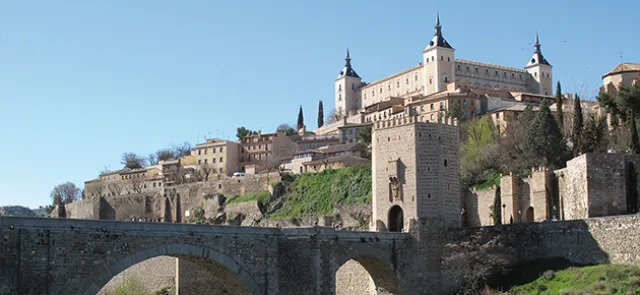
To understand the importance of Gerard of Cremona, it is essential to place his work in the context of the Reconquista, the military and religious movement by which the Christian kingdoms of Spain sought to retake territories under Muslim rule. In 1085, Alfonso VI, King of Castile and León, conquered Toledo, one of the principal cities of Al-Andalus (the part of the Iberian Peninsula under Muslim rule, whose borders shifted constantly with the victories and defeats of the Christian kingdoms against the Muslims). This conquest brought Toledo under Christian control, but the city, shaped by a long period of Muslim rule, retained a mixed population of Muslims, Christians and Jews. This coexistence fostered an intellectual environment in which cultural and scientific exchanges were particularly rich.
Toledo quickly became a crossroads of learning, a striking example of unprecedented cultural syncretism. With its libraries teeming with manuscripts, the city became an essential hub for European scholars, drawn by the wealth of knowledge offered by works available in Arabic, spanning a vast range of disciplines from philosophy and medicine to mathematics, astronomy and astrology.
In this context, the cathedral school\* of Toledo, under the patronage of Alfonso VI, played a key role in translating these texts into Latin. Gerard of Cremona, who came from northern Italy, joined this dynamic center of translation around 1140. Drawn to astronomy, a discipline in which scholars of the Islamic world had made considerable advances, he settled in Toledo to gain access to works unobtainable in the West.