Anyone who has ever moved furniture through a tight space knows how difficult it can be. But did you know that this has given rise to a famous geometry problem? The celebrated moving sofa problem was formalized in 1966 by the Canadian mathematician Leo Moser (1921–1970). The challenge is to find the "sofa" with the largest possible area that can be maneuvered around a right-angled corner in a corridor one metre wide. A square with side length 1 (and area 1) obviously works, but larger examples are easy to find. A semicircle of radius 1 (with an area of approximately 1.57 m2) is already a better candidate.
The shape shown opposite, proposed in 1968 by Britain's John Hammersley (1920–2004), consists of two quarter-discs of radius 1 and a rectangle of length 4/π with a semicircle cut out along its entire length. It fits perfectly through the corridor and has an area of π/2 + 2/π ≈ 2.207 m2. John Hammersley also established an upper bound on the maximum area; in 2017, Yoav Kallus and Dan Romik lowered this bound to 2.37 through research involving a hefty dose of computing.
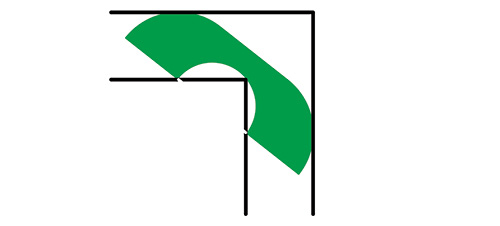
Hammersley's sofa makes it through!
The perfect sofa
-------------------