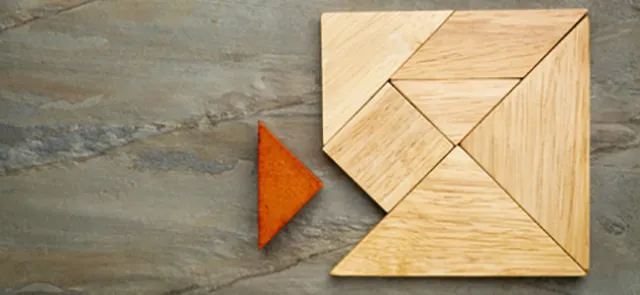
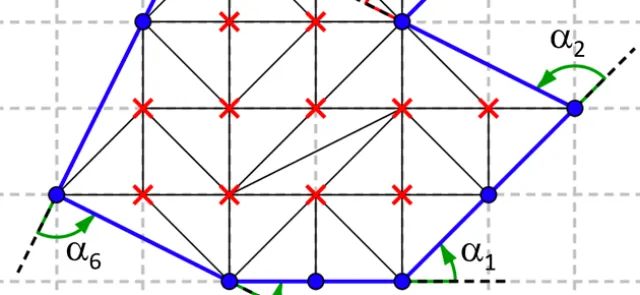
A necessary condition for two polygons to admit the same polygonal dissection—we shall say that they are equidecomposable—is, of course, that they have the same area. We shall call them equivalent (see box). But constructing a polygon also requires moving its constituent pieces. This may seem trivial, but such movements are operations specific to a particular geometry. We shall confine ourselves to Euclidean geometry, which is based on the group of similarities, comprising translations, dilations and rotations. The isometries we shall consider are translations and rotations, thus excluding reflections across a line because they require the pieces to be turned over—that is, taken out of the plane and into the third dimension.
Shared credit
--------------------------
The converse, "two equivalent polygons are equidecomposable," is the statement of a theorem attributed to several authors. Farkas Bolyai (1775–1856), the father of János (who discovered a "new world," hyperbolic geometry), seems to have been the first to pose the problem, in 1790. It is said to have been proved by John Lowry (1769–1850) in 1814, William Wallace (1768–1843) in 1831, Bolyai himself in 1832 and Paul Gerwien (1799–1858) in 1833. However, since publications by only the last two are readily available, this result is most commonly called Bolyai's theorem, or the Bolyai–Gerwien theorem.
Thus, given two polygons of the same area, it is always possible to find a polygonal dissection that reassembles each polygon into the other.