



A world with many sides
Polygons largely exceed the strict framework of geometry, with practical or recreational applications. They can be found, for example, in architecture, in building plans, or in arithmetic in the form of so-called polygonal numbers. They are naturally the tessellations of many puzzles, including the oldest of them all, Archimedes' Stomachion. It was left to Bolyai, the grandfather of non-Euclidean geometry, to prove that two polygons of the same area can have the same constituent pieces. Since then, Dudeney and the Demaines, father and son, have opened a vast field of mathematical creations – and recreations – with hinged polygons.
All articles in this folder
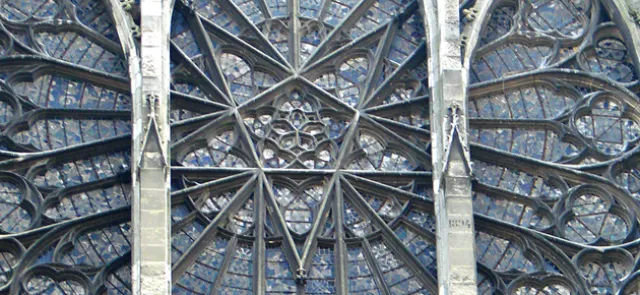
Pentacles and pentagrams: symbols and mathematics | Tangente
The pentagram, also known as the star pentagon, is a non-convex pentagon formed by joining every other vertex of a regular pentagon. It has journeyed through the ages and across civilizations, always shrouded in mystery.
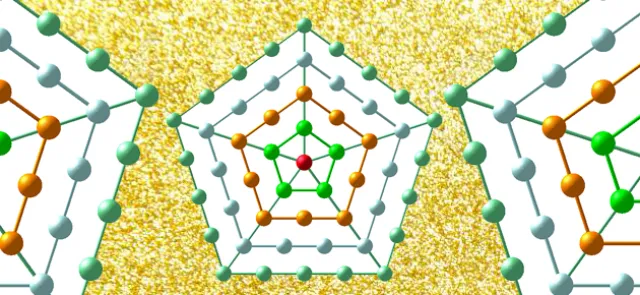
When polygons form numbers
All is number! The Pythagorean school established many properties of numbers from their geometric representations. First developed for triangles and squares, this way of arranging numbers was later extended to all kinds of polygons.

Maulnes Castle: Renaissance architecture on a pentagonal plan | Tangente
Few people know that less than 200 km from Paris stands a Renaissance castle built to a pentagonal design. Only a handful of such buildings can be found anywhere in the world...

Squaring polygons
Archimedes' Stomachion, the world's oldest puzzle, can produce thousands of shapes from fourteen polygonal tiles. But what about the inverse problem? Under what conditions do two given polygons have a common polygonal dissection, and how can one be found?

Pentagonal architecture: towers, castles and the Pentagon | Tangente
The pentagonal tower has stood since the 14th century in Castellane, a fortified town and subprefecture of Alpes-de-Haute-Provence.

The one-cut theorem: any polygon in a single cut | Tangente
Can a polygon be cut from a sheet of paper with a single straight cut? Surprisingly, the answer is yes! More surprisingly still, this also applies to other objects.

Jolygons: iterative polygonal spirals | Tangente
This is not a polygon

Vertex figures: duality and Platonic solids | Tangente
A polyhedron is an assembly of polygons with vertices, edges and faces, arranged so that every edge is shared by two faces.

Polygonizing a number: histonumbers and Theodorus' spiral | Tangente
Several methods can be used to associate a polygon with a given number.