Wooden knot puzzles
-----------------
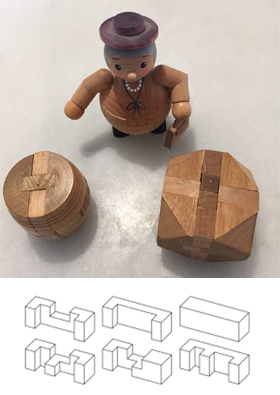
Wooden knot puzzles are the best known and probably the oldest interlocking puzzles. The aim of the game is to take apart and then reassemble the elements, made from wooden pieces notched in various ways, with a peg locking everything together. These solid puzzles, known as ideal, are fairly easy to solve once the locking peg is found, and hold little further interest for enthusiasts.
This mechanical puzzle has been known, in various forms, since at least the early 18th century.
-
Burr puzzles
----------------------
The contemporary versions of wooden knot puzzles, called burr puzzles, in turn hold immense appeal for enthusiasts. Bill Cutler was a major architect of this revival, thanks to a computer analysis carried out around 1975 and popularized by Martin Gardner starting in 1978.
Unlocking these puzzles is itself a challenge. These puzzles' difficulty is determined by the number of pieces and the number of moves needed to remove the first part of the puzzle, known as the key, which then allows the rest to be dismantled.
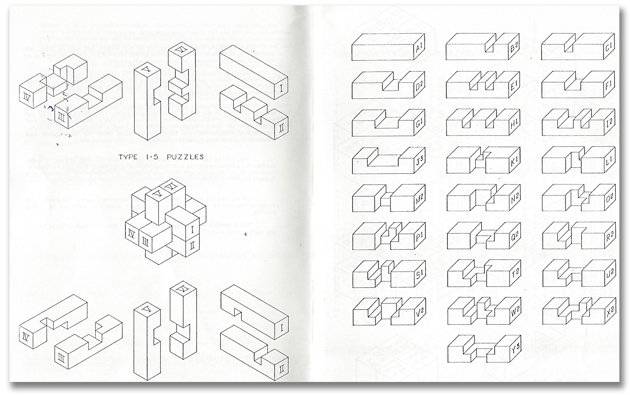
Bill Cutler's first analyses, in Chinese Cross (Pentangle, 1979).
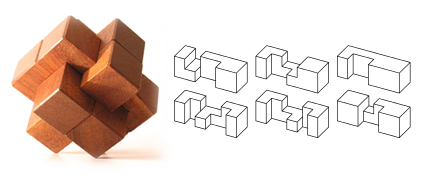
The version of the good-luck Chinese knot puzzle shown below, designed by Bill Cutler, requires five moves.
A little vocabulary…
----------------------

Why is the expression "burr puzzle" used to describe a category of mechanical puzzles? The term comes from the English word burr, "burdock," since for some people, in the early 20th century, these objects evoked the hunt for this summer plant's seed…
First, where does the word "puzzle" come from? The cartographer John Spilsbury is said to have invented the puzzle around 1760 as a playful way to learn geography. The word comes from the verb to puzzle ("leave perplexed"). Its etymological lineage could be: opponere ("to oppose, set against" in Latin), aposer ("to object, to reason" in Old French), pose, then pusle (cf. also to perplex in Old English).