A big annual gathering
----------------------
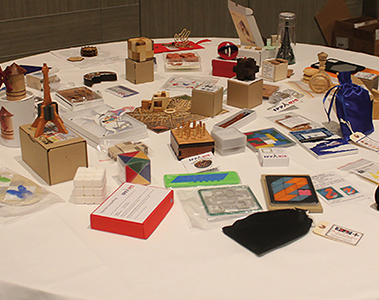
Puzzles competing in the best-design contest.
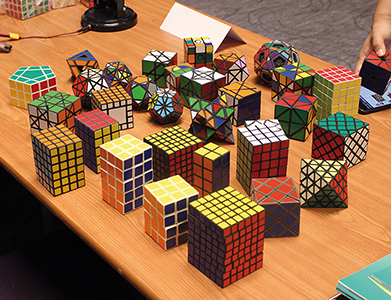
A table at the puzzle market.
Jerry Slocum, puzzle historian
---------------------------------------
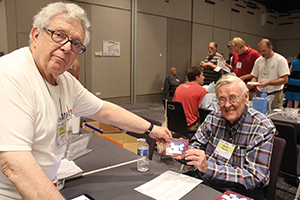
Alain Zalmanski and Jerry Slocum
during the puzzle exchange.
With a group of enthusiastic friends, Jerry Slocum founded the International Puzzle Party (IPP) in 1978, with the aim of presenting and exchanging mechanical puzzles. An engineer by training and a historian of puzzles, he has contributed to numerous reference works: Puzzles Old and New: How to Make and Solve Them (University of Washington Press, 1986) and New Book of Puzzles, 101 Classic and Modern Puzzles to Make and Solve (Freeman, 1992) with Jacob Botermans; The Anchor Puzzle Book (self-published, 2012) with Dieter Gebhardt; the 1993 Horden reissue of the classic Professor Hoffman's Puzzles Old and New (Angelo John Lewis, Warne, 1893)…
Slocum is, above all, the author of three landmark works on the iconic puzzles — the 15 puzzle (The 15 Puzzle, self-published, 2006), the tangram (The Tangram Book, Sterling, 2003) and the Rubik's Cube (les Secrets du Cube, French translation POLE, 2010).
In 2006, he donated thirty-one thousand puzzles and four thousand books to the Lilly Library at Indiana University (Bloomington, United States). This was the first time such a collection had been made available to researchers and the general public.