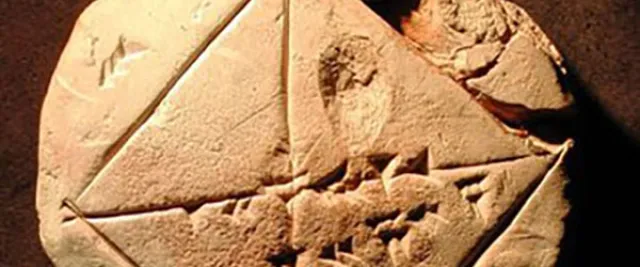
The first proof of the Pythagorean theorem is based on a construction involving the right triangle ABC. The square ACDE is constructed on the hypotenuse, and the squares AA'B'C and DFB'D' on its legs. The dissection also reveals four triangles, numbered 1 to 4, together with a polygon, shown here in gray.
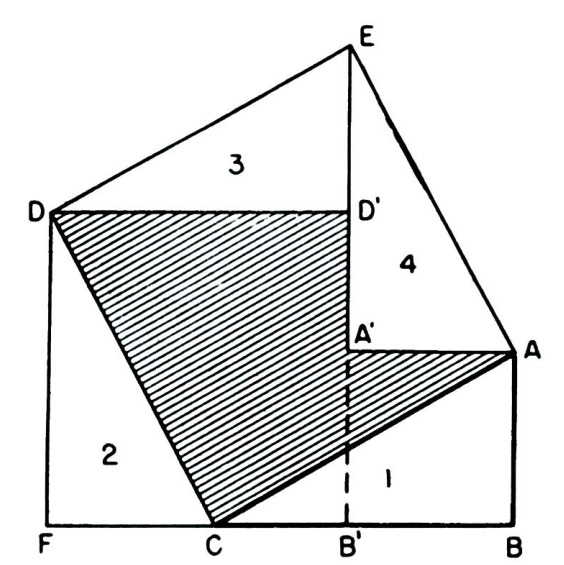
ACDE is then seen to consist of the gray polygon together with regions 3 and 4, while the two squares AA'B'C and DFB'D' together consist of the same polygon and regions 1 and 2. But the four triangular regions are all equal by construction. Thus, the square constructed on [AB] is indeed equal to the sum of the squares constructed on [AC] and [BC].
The second proof
----------------------------
The second proof uses a different construction involving the right triangle ABC. First draw the squares on the legs, then complete the figure by adding a rectangle between them (which, algebraically, represents twice the product of the legs) and the square constructed on [AB].