



The geometric tradition
Arab-Muslim geometry is based on Greek treatises in order to study them more deeply. This is the case of Euclid's treatises, some of which were lost in the original Greek, but which we are able to reconstruct thanks to commentators in the Arabic language who, moreover, offer us original works such as very clever proofs of the Pythagorean theorem. This is also the case with astronomy, long considered a fundamentally geometric science. More surprisingly, this geometric deepening is also found in algebra where it is used to develop general methods of resolution. Thus, geometry is part of a tradition that scholars from Islamic lands considerably extend and refine.
All articles in this folder

In search of Euclid's lost treatise On Divisions | Tangente
Several of Euclid's texts have been lost, including a treatise on the division of plane figures. Fortunately, the abundant commentaries and extensions written by Arab mathematicians have made it possible to investigate this lost manuscript.

Thābit and the Pythagorean theorem
In Sur la preuve attribuée à Socrate au sujet du carré et de sa diagonale (On the Proof Attributed to Socrates Concerning the Square and Its Diagonal), Thābit ibn Qurra examines how squares can be dissected, taking as his starting point the famous example from Plato's Meno. This gives him an opportunity to present two proofs of the Pythagorean theorem and to generalize it.
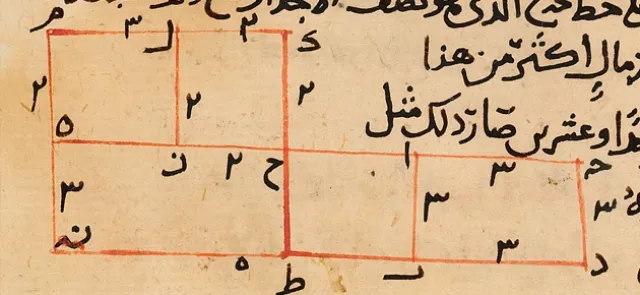
Al-Khwārizmī's geometry of equations
Quadratic equations have been solved by geometric methods, of varying degrees of sophistication, since Babylonian times. Similar methods appear in the works of Greek authors. But al-Khwārizmī was the first to set out a clear, general method.
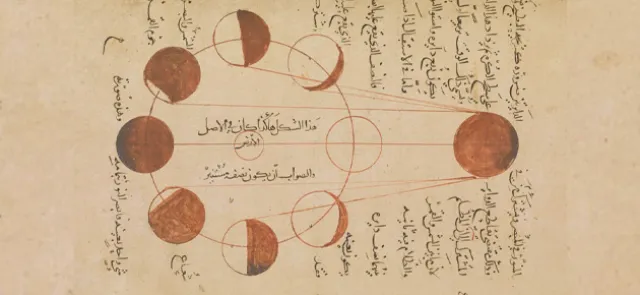
Al-Biruni reads Ptolemy: planetary distances | Tangente
Drawing on his extensive knowledge of the astronomy and mathematics of his time, al-Bīrūnī succeeded in making Ptolemy's highly complex method for calculating distances between the planets comprehensible. Devised in the 2nd century, it was a decisive step towards modern astronomy.