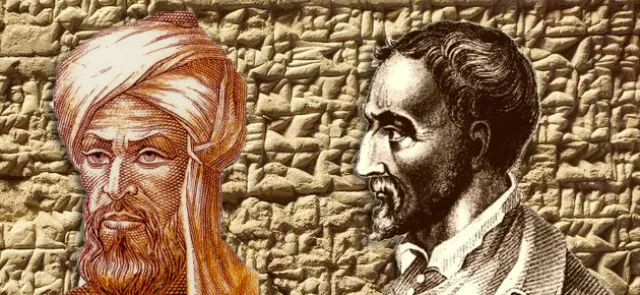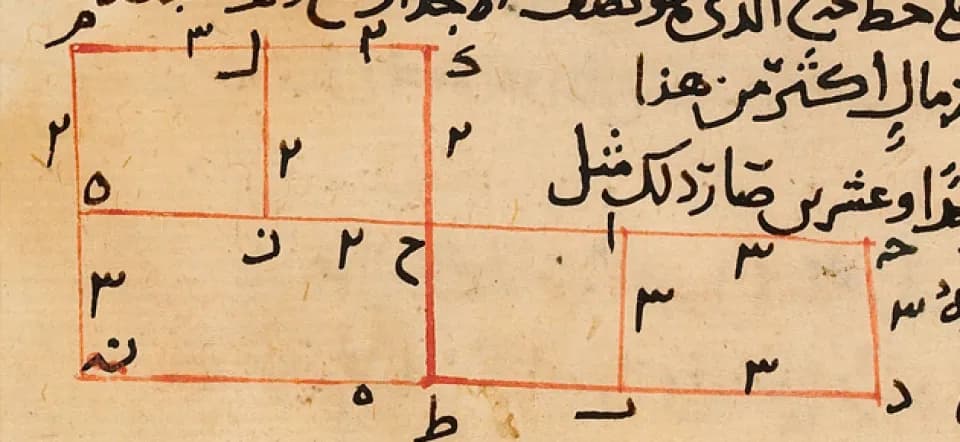
Geometry and algebra are closely linked: simply calling powers "squares" and "cubes" clearly invokes the corresponding geometric concepts. The algebraic quantity *x 2 is the area of a square with side length x. Thus, solutions of quadratic equations appear on very ancient Babylonian tablets, while some of Euclid's geometric properties can be read as algebraic methods for solving quadratic equations. Yet it is in al-Khwārizmī that we find, for the first time, an approach that is both very clear and very general.
Quadratic equations in Babylon
------------------------------
Quadratic equations have been known and solved for a very long time. They occur in Babylonian mathematics, for example on tablet BM 13901, dating from around 1700 BC. The first of its roughly twenty problems states: "I have added the area and the side of my square: 45."
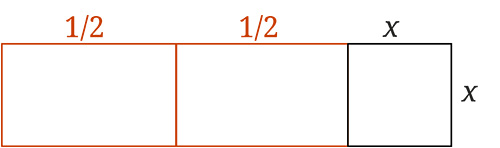
In modern terms, this means *x 2 + x = 3/4. In the sexagesimal numeral system, 45 is three-quarters of 60. The solution method calls for geometric reasoning: first, we draw a square (in modern terms, we would say that its side length is x), then add a rectangle with one side of length 1 (and therefore area x), which we divide into two equal parts.