Spherical triangles
------------------------
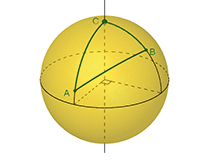
Pythagoras' theorem holds in the plane, as is easily verified. But imagine that we are navigators crossing perfectly calm oceans. The shortest path between two points on the globe is not a straight line, but an arc of a circle with the same center as the sphere (whose radius may be set to one for simplicity). These lines can be used to construct spherical triangles, and several formulas allow us to determine their side lengths. But there is a surprise: Pythagoras' theorem does not hold (see Tangente 151, 2013). We can construct equilateral (spherical) triangles with three right angles. So what about Pythagoras' theorem, that old standby? Fortunately, there is a spherical version: if ABC is right-angled at C, then
A characterization of geometries
----------------------------------
Right triangles reveal a great deal about the space in which we are working. It can be proved that Pythagoras' theorem is in fact equivalent to the famous parallel postulate, which characterizes Euclidean geometry and states that through any given point there passes exactly one line parallel to a given line.
If we assume instead that more than one line parallel to a given line passes through a given point, then the Pythagorean relation becomes AB2 > AC2 + BC2.
Now consider the sphere's great circles (those with the same diameter as the sphere). They all intersect. In spherical geometry, therefore, no line parallel to a given line passes through a given point. Here, the Pythagorean relation becomes AB2 < AC2 + BC2.
The direction of the inequality is in fact related to the geometry being used, and particularly to its curvature. Equality holds only for a geometry with zero curvature, as in the plane. A close analysis of the formulas that replace the Pythagorean relation in spherical and hyperbolic geometries nevertheless shows that, locally, for "small" triangles, the equality comes close to holding: these geometries are then well approximated by Euclidean geometry.
Hyperbolic triangles
---------------------------
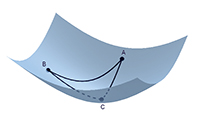
The approach used on the sphere can be adapted to other surfaces. Consider Minkowski space, which is very useful in special relativity. Here we are walking on one sheet of a hyperboloid (a surface of revolution obtained by rotating one branch of a hyperbola), on which distances are calculated using a particular formula.
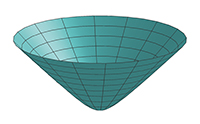
In this setting too, we can draw right triangles… but Pythagoras' theorem no longer holds! Here again, there is an elegant result, which, incidentally, is reminiscent of the result from spherical geometry: if ABC is right-angled at C, then
where cosh is the hyperbolic cosine function, defined by