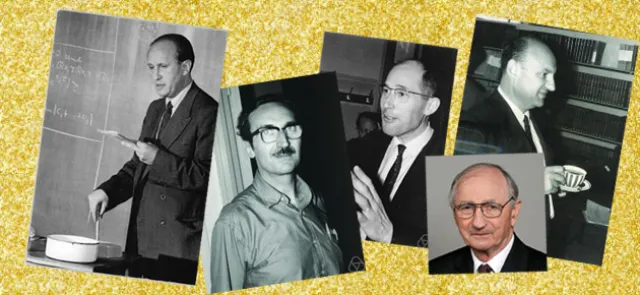
A distance between mathematicians
---------------------------------
The mathematician Paul Erdős (1913–1996) was a major figure in 20th-century mathematics. He left an impressive scientific legacy. In particular, he wrote some 1,600 research papers in a wide range of fields (number theory, combinatorics, graph theory, topology, probability, geometry, analysis…). He remains well known today because his name is attached to several dozen conjectures on which leading contemporary mathematicians, including Tim Gowers and Terence Tao, are working.
Throughout his career, Erdős led an almost nomadic life, travelling from city to city as he encountered mathematicians working on the same problems, and published papers with more than 500 different coauthors. This feature led to the creation of the Erdős number, which measures, in a sense, how "close" a researcher is to Hungary's most famous mathematician through successive collaborations.
Erdős himself—and no other mathematician—has an Erdős number of 0. Someone with an Erdős number of 1 has written a research paper with the Hungarian mathematician. Someone with an Erdős number of 2 has coauthored a paper with one of Erdős's direct collaborators, but not with Erdős himself. And so on. We can therefore consider the graph whose vertices are research mathematicians, with an edge between two distinct vertices whenever the two authors have coauthored at least one paper. The Erdős number of a vertex is then the minimum length of a path connecting that author to Paul Erdős.
Properties of Erdős numbers
----------------------------------