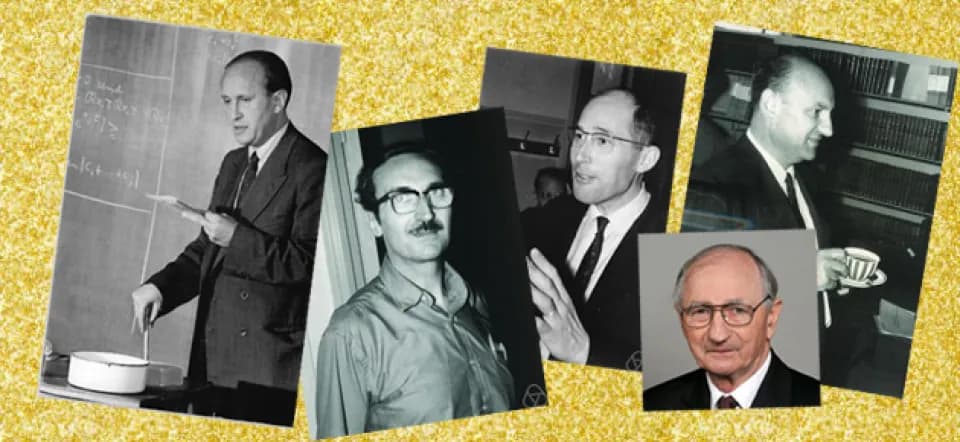
When he published his elegant proof of Bertrand's postulate in 1932 (see the article), Erdős was only 19. Over the following sixty years, more than 1,500 articles would follow. A singular figure, he combined an exceptional scientific vitality with distinctly original traits. During the 1950s, he became an itinerant mathematician. Like no one else, he inspired intense collaboration. More than 500 mathematicians would go on to work with him. All the papers he co-authored can be seen as the first level of an immense graph with him at its center.
The French mathematician Marcel Berger (1927-2016) discusses him in his remarkable book Géométrie vivante ou l’échelle de Jacob (Living Geometry, or Jacob's Ladder; Cassini, 2009): " Erdős's name deserves special mention; besides his many results and countless lectures, he was known for having, at the end of his lectures, a fairly long line of researchers waiting. Each in turn would say to him: ' Professor Erdős, I don't know how to solve such-and-such a problem'. Almost invariably, the reply was: ' This is how it should be done: write the paper, and we'll sign it together'. Given the countless articles thus written jointly with him, practically every mathematician of a certain age belongs to Erdős's connected component and therefore has an Erdős number, defined as follows: it is the minimum number of links in a chain of joint articles that ends with a paper co-authored with Erdős."
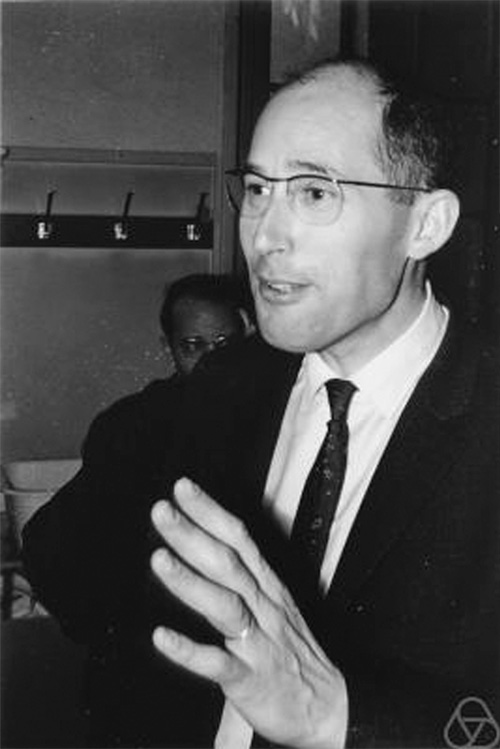
Marcel Berger (1927-2016).
Erdős is pivotal
---------