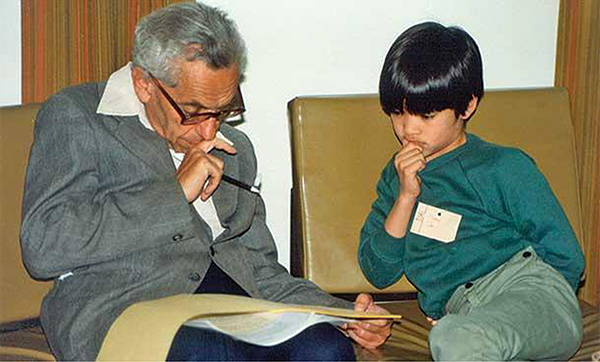
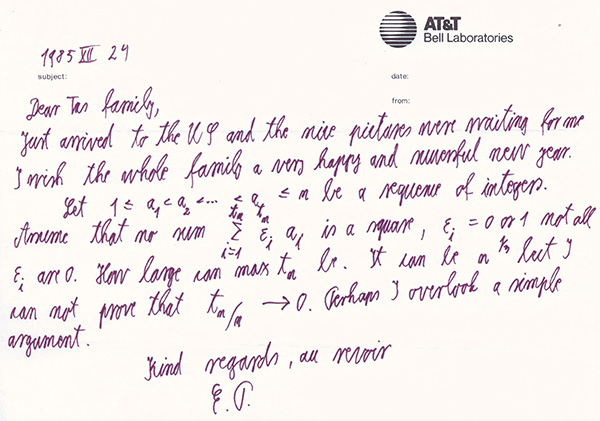
The two mathematical legends seated side by side were captured for posterity by Terence Tao's parents in Adelaide, Australia, in 1985. At 72, Paul Erdős was, of course, already regarded as an extraordinarily prolific giant. Little Terence was only 10, but his exceptional gifts had already been recognized. In the famous photograph, the two enthusiasts are engrossed in an elegant problem posed by Erdős. To understand it, consider the set [1, 10] of integers from 1 to 10. Take a subset, for example {2, 3, 6, 7, 8}. By adding some of these numbers, you can obtain a square: here, 3 + 6 = 9 or 2 + 6 + 8 = 16. With the subset {5, 6, 7, 8}, however, no such sum is a square. You can even check that every subset of [1, 10] containing five or more elements will always yield a square. More generally, Erdős put the following question to the young Tao: for each integer N, what is the size of the largest subset A of [1, N] with no subset summing to a square? Erdős had observed that the size of the largest subset A, denoted by |A|, was greater than
-
A young boy with a bright future
------------------------------