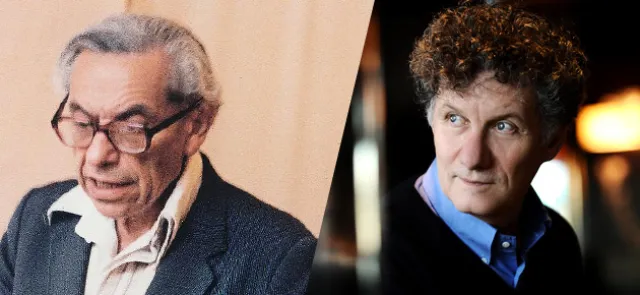
An image is often associated with him: that of a man, roaming the world, suitcase in hand, a problem in almost every city.
But it would be a shame to reduce him to the mere eccentricities of his lifestyle, or to his reputation as a serial solver.
He was interested in very specific problems, but he often invented innovative approaches and clever techniques to solve them. One of his guiding ideas was: "You sometimes have to complicate a problem in order to simplify its solution." This led to the development of new ideas, by him or by others, giving him a unique place in the creation of theories.
He was interested in almost every field, but his passion was, without doubt, numbers. In fact, it was in this field that he obtained his first result, at the age of nineteen. Among other things, he introduced a probabilistic approach there which, surprisingly, made it possible to prove numerous results with certainty. These probabilistic arguments are also found elsewhere, such as in graph theory and combinatorics, on which he left his mark.
His approach to tackling problems was strongly focused on ongoing collaboration with hundreds of mathematicians, and this no doubt allowed him to spread his methods. In this respect, he was an exceptional catalyst for mathematical progress.
Contrary to certain preconceptions, perhaps as a result of the influence of the Bourbaki group in the second half of this century, it is not only the "theory builders" who advance mathematical research. Paul Erdős solved hundreds of problems, often via original approaches, later taken up and expanded by others, but he posed far more, many of which are still awaiting a solution. He is considered by specialists to be one of the most important mathematicians of the 20th century.
So let's discover this extraordinary character…