



Classics at the summit
Since Antiquity, people have been interested, for land redistribution problems, in calculating the area of a quadrilateral. The Indian mathematician Brahmagupta established a formula from the measure of its sides, a formula similar to that of Heron of Alexandria for triangles. A generalization of these expressions has recently made it possible to determine the area of any pentagon from its sides. Another ancient problem, the construction of regular polygons with a ruler and compass. It would be necessary to wait until the 19th century, the work of Gauss and the development of Galois theory, to determine which ones are indeed constructible according to the rules of Euclid.
All articles in this folder
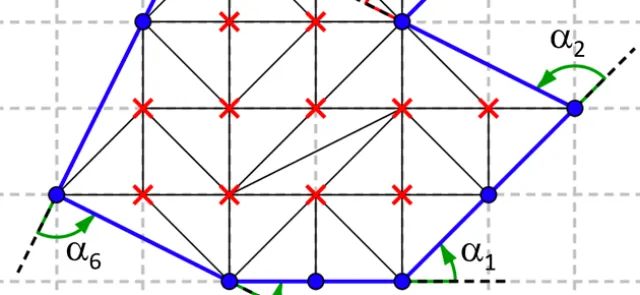
Pick's theorem: an inspiring formula for polygonal area | Tangente
Some theorems, through the simplicity of their statements and the originality of their proofs, become enduring examples of mathematical creativity. Pick's theorem is one such example.

Polygon taxonomy: triangles and quadrilaterals | Tangente
Just as a taxonomist inventories and classifies living species, whether animal or plant, let us classify the simplest polygons by comparing their angle measures and side lengths.

Tangential quadrilaterals
Engineer Henri Pitot (1695–1771) is remembered for the tube that bears his name, which he proposed in 1732 to "measure the speed of flowing water and the wake of ships" and which is still widely used in aerodynamics. But geometry was this self-taught scholar's first love.

Heptadecagon: fact and fiction
Theory tells us that a regular seventeen-sided polygon—a heptadecagon—can be constructed using only a straightedge and compass. But it gives no details of the construction, which is far from straightforward.

Pythagoras and Heron
Heron's formula emerges when we seek to express the area of a triangle in terms of its side lengths. A variation of the argument recovers the Pythagorean theorem.
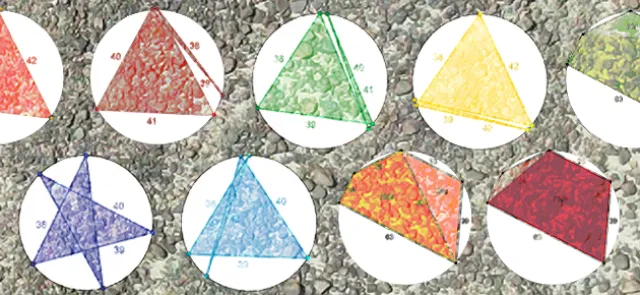
Robbins pentagons
While the geometry of triangles and quadrilaterals has been studied in detail for many centuries, the geometry of pentagons has only recently begun to be explored. Let's follow in the footsteps of Heron, Brahmagupta and Robbins.

A little gem from Gauss
Triangles and quadrilaterals have inspired a wealth of mathematical literature. Yet few people seem to have taken a close interest in pentagons before a certain Carl Friedrich Gauss, who gave us a little gem for calculating their areas.

Largest small polygon: max area at fixed diameter | Tangente
Let us consider polygons of diameter at most one—that is, polygons in which the distance between any two points is no greater than one—and determine which has the greatest area.